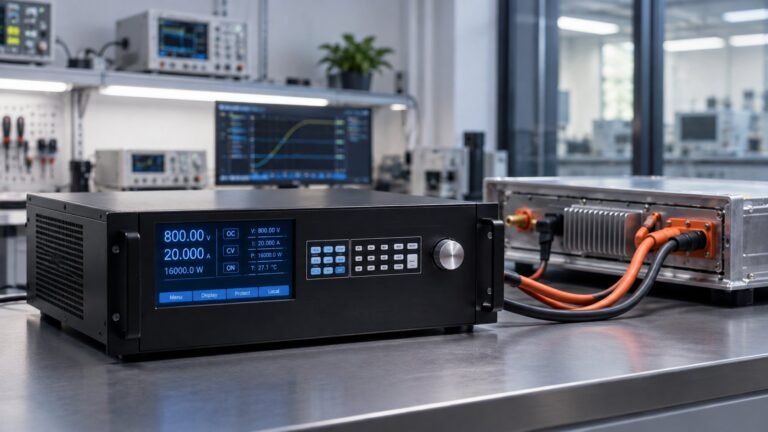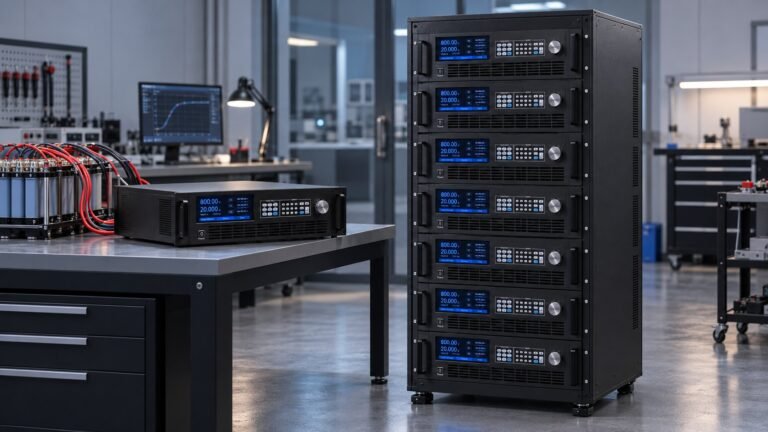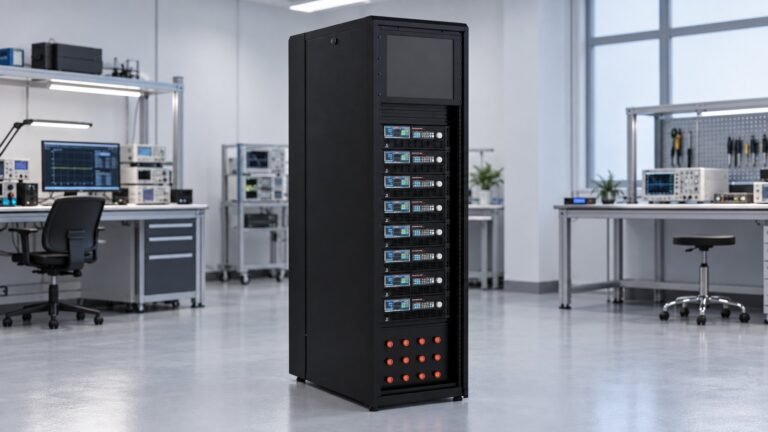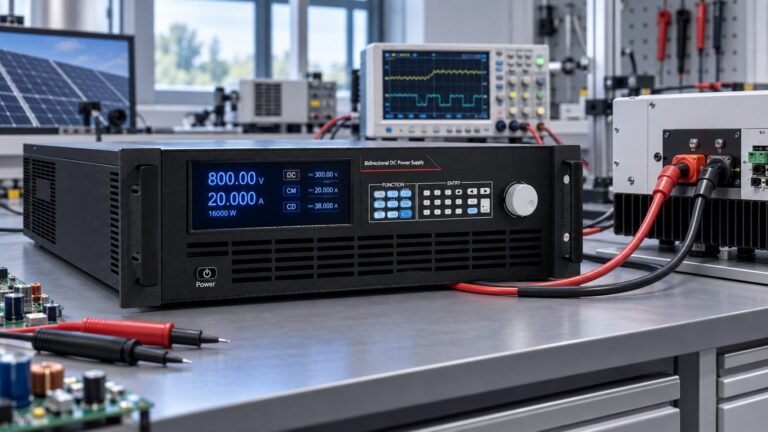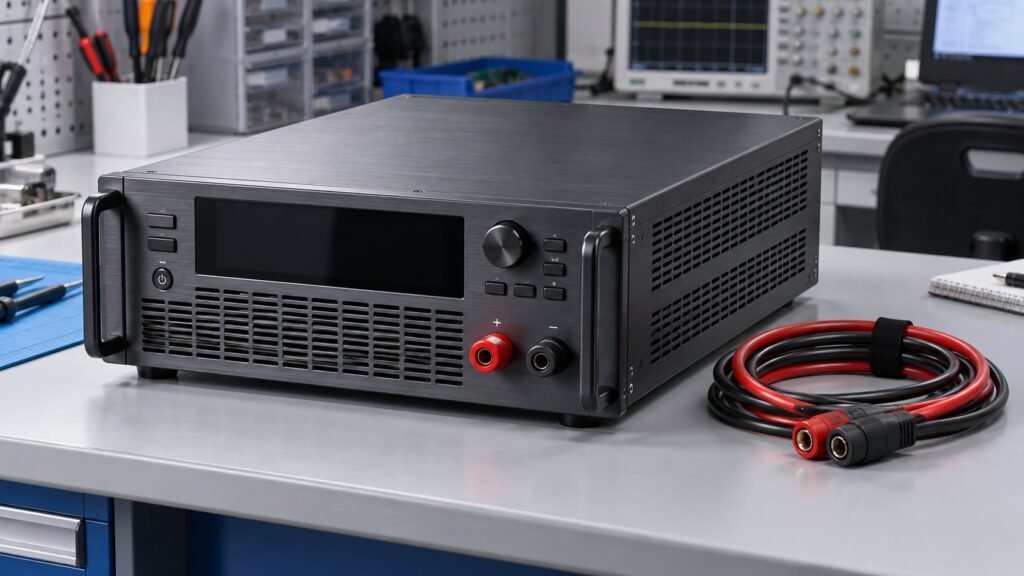
Bidirectional DC power supply model numbers follow a simple pattern once you know the fields: manufacturer and power-tier prefix, then rated voltage, then rated current. ITECH’s IT-6036C-2250-50 decodes to 36 kW, 2250 V and 50 A — TestEquity UK lists the same three figures on the product page, and the IT6000C datasheet confirms them. Learn that pattern and a fragment like 2250-455 or 2250-650 stops looking like noise and starts looking like a spec you can cross-reference.
You’re probably here because a competitor’s part number turned up in a test report or an RFQ, and you need to know what it means before comparing it to anything else. This piece covers how to read power supply model numbers on 2250 V bidirectional units, why two manufacturers can share that voltage class and still differ by ten times in power, and where UltraPower’s own 2250 V lineup lands against the code you searched for.
The logic behind bidirectional DC power supply model numbers
Take the ITECH code apart left to right. IT-6036C is the series and power-tier designator — the 6000C family, at the power tier this chassis sits in, roughly 36 kW. 2250 is the rated output voltage in volts. 50 is the rated output current in amps. That’s the whole pattern: prefix, voltage, current. Once you know the order, you can read almost any bidirectional DC power supply model number the same way, regardless of manufacturer.
- Identify the prefix — series name and rough power tier.
- Read the first number after the prefix as rated voltage, in volts.
- Read the final number as rated current, in amps.
- Check the datasheet for actual rated power — it isn’t always voltage × current.
That last step matters. Multiply 2250 V by 50 A and you get 112.5 kW — but ITECH rates this chassis at 36 kW, per the IT6000C datasheet. Voltage and current are independent maximums here, not a promise you can hit both at once. The power stage, not the label, sets the real ceiling.
See also: ac to dc converter regeneration commissioning guide
2250 V doesn’t fix the current or the power rating
The IT6000C series spans seven voltage grades from 80 V to 2250 V, with current ratings up to 2040 A across the family, according to the datasheet. That range means two units can carry the same 2250 V class and still sit worlds apart in capability. A 2250V DC power supply current rating of 50 A on one chassis and a much higher figure on another — inside the same series — produces very different power outcomes, even though the voltage digit in the model number is identical.
This is why the current field, not the voltage field, is usually what a buyer is hunting for when searching a partial model code. If your test plan is fixed at 2250 V, current is the number that decides whether one chassis covers your load or you need to parallel units.
See also: IEC 61000-4-29 DC Power Supply: Test Bench Guide
Same voltage class, two different engineering answers
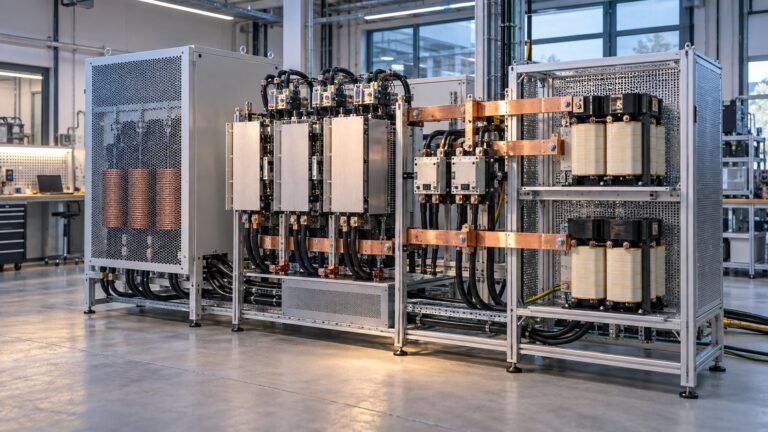
ITECH’s IT6000C reaches its highest power by master-slave paralleling with averaging current distribution, scaling the family up to 1.152 MW, per the datasheet. GW Instek takes a different route at the same 2250 V class: its RBS series unit tops out at 510 A in a single 3U chassis, and reaches 300 kW only by paralleling ten units in master-slave configuration, per GW Instek’s announcement of the expanded RBS range. Same voltage class, same general paralleling concept, different per-chassis current and different unit count to reach high power.
What that means for your shortlist
If you’re comparing quotes at 2250 V, don’t stop at the voltage digit. Ask two questions: what’s the per-chassis current, and how many chassis does the quoted power figure actually require? A 300 kW figure built from ten paralleled 3U units behaves differently on your bench — more cabling, more control synchronisation, more rack space — than 300 kW from two or three larger chassis.
What ‘2250-455’ and ‘2250-650’ searches are really asking
Strip the prefix and you’re left with a voltage current code DC supply buyers use to cross-reference parts: 2250 paired with 455, or 2250 paired with 650. Read them the same way as the ITECH example — 2250 V rated, then 455 A or 650 A rated. Multiply and you get roughly 1.02 MW and 1.46 MW of theoretical capacity. Neither figure fits in a single chassis at today’s 2250 V power densities — ITECH’s or GW Instek’s — both would need master-slave paralleling to reach those currents at that voltage, the same approach each vendor already uses to scale past its standalone limit.
In practice, someone typing that fragment into a search engine already has a spec sheet open and wants to know what else hits the same number. That’s a cross-reference search, not a curiosity search — and it’s exactly what the rest of this page answers.
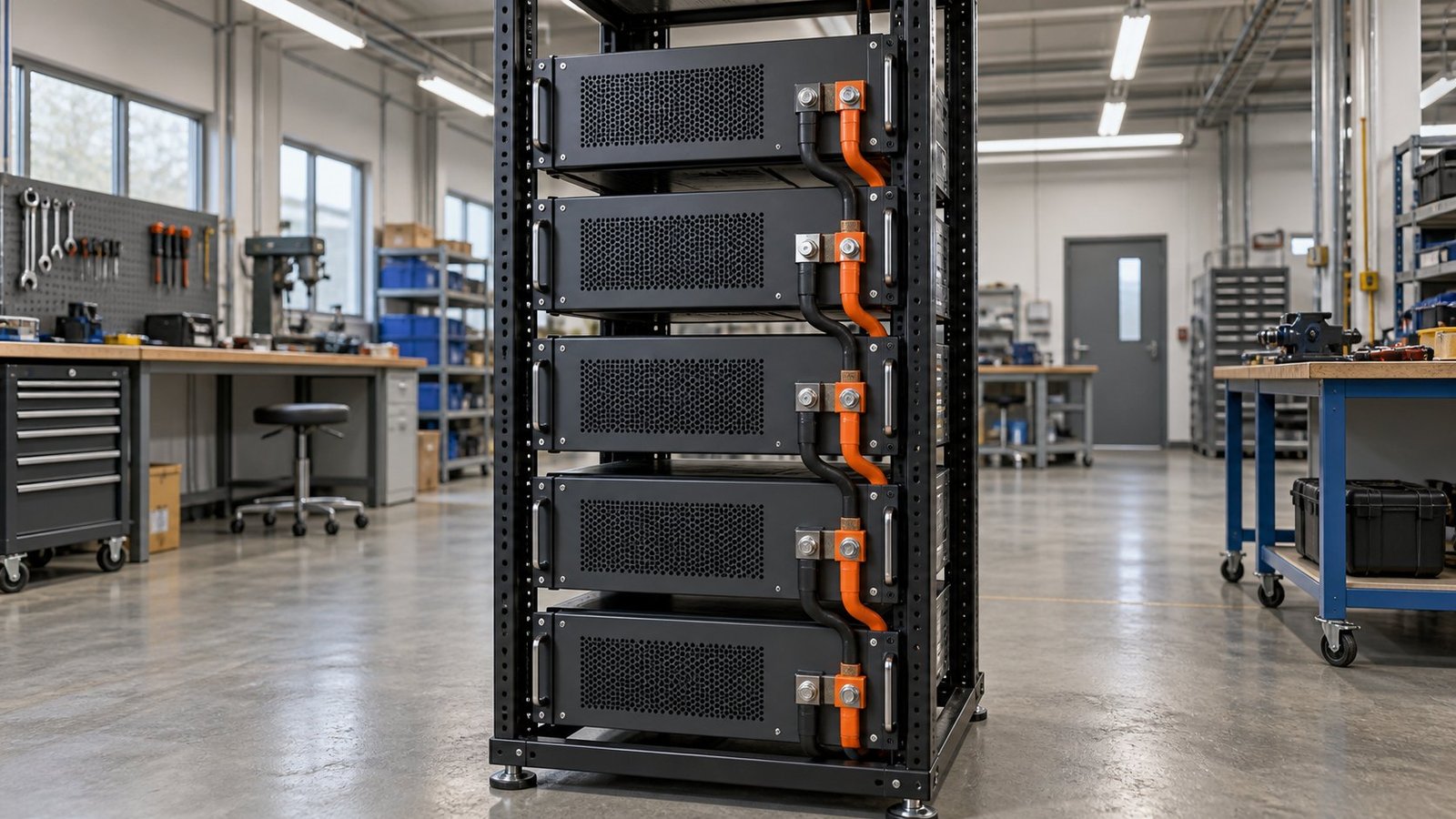
UltraPower’s 2250 V lineup, mapped to the code you’re searching for
UltraPower’s 2250 V class runs from 22 kW to 420 kW across five current tiers. Each tier is specified so rated voltage times rated current equals the nameplate power — no gap between the label and what the chassis actually delivers, unlike the ITECH example above, where the power stage sits below the full voltage-times-current product.
- UP-2250-10 — 2250 V, 10 A, 22 kW
- UP-2250-25 — 2250 V, 25 A, 56 kW
- UP-2250-50 — 2250 V, 50 A, 112 kW
- UP-2250-100 — 2250 V, 100 A, 225 kW
- UP-2250-187 — 2250 V, 187 A, 420 kW
None of these single chassis reaches the 1 MW-plus territory implied by a 2250-455 or 2250-650 style code — and neither does a single ITECH or GW Instek unit. Getting there means paralleling, the same way GW Instek links ten RBS units to reach 300 kW. If your load needs that current at 2250 V, tell our Request a Quote team the target current and we’ll scope how many UP-2250 chassis it takes. For definitions this page doesn’t repeat, the Spec Glossary covers the full multi-class terminology, and Downloads & Datasheets has the per-unit numbers.
FAQ: reading bidirectional DC power supply model numbers
What does the number after the voltage mean in a DC power supply model code?
It’s the rated output current in amps. In IT-6036C-2250-50, that’s 50 A. In UltraPower’s UP-2250-100, it’s 100 A.
Does multiplying voltage by current always give the rated power?
No. Some chassis — including the ITECH example above — rate voltage and current as independent maximums, so the real power ceiling is lower than the product of the two. Check the datasheet figure, not just the model number.
Can I match a competitor’s 2250 V current rating with an UltraPower unit?
Usually yes, across our five 2250 V tiers from 22 kW to 420 kW. For currents above 187 A at 2250 V, we parallel chassis — tell us the target current via Request a Quote and we’ll confirm the configuration.
Why do some 2250 V units need master-slave paralleling to reach high power?
Because per-chassis current is limited by the power stage inside a given rack size — GW Instek’s RBS chassis caps at 510 A in 3U, for example. Paralleling adds current from multiple identical units under shared control rather than redesigning one larger chassis.
Where to go from here
Once you’ve matched a competitor’s voltage-current code to the power figure you actually need, the next step is picking the chassis. Our 2250 V Bidirectional DC Power Supplies page lists all five UP-2250 tiers with full electrical specs, so you can go straight from the code you searched to the unit that matches it →