
Simulation & Automation
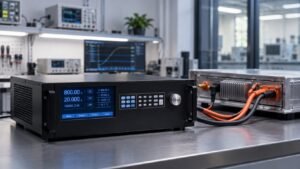
Bidirectional Battery Simulator Transient Response
Bidirectional battery simulator transient response is the measured time and voltage error when your DUT reverses current from source to sink and…
Read guide →Resources
Bidirectional battery simulator transient response is the measured time and voltage error when your DUT reverses current from source to sink and…
Read guide →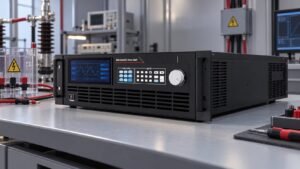
For IEC 62109-2 2026, change your PV inverter safety testing plan to include controlled full-load-to-zero and zero-to-full load steps. Repeat each direction…
Read guide →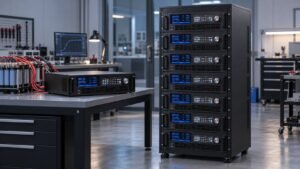
A regenerative dc converter replacement should be selected from measured source and sink limits, not the old unit’s nameplate alone. Record your…
Read guide →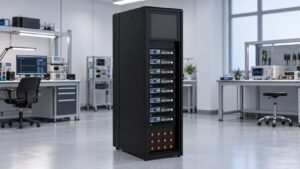
The August 2025 publication of T/CPSS 1014—2025 sets the cell-level reference for EV battery simulator accuracy: a simulator for nominal cell voltages…
Read guide →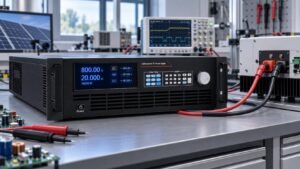
An IEC 63409-3 DC test setup is an auditable PV PCE bench that records the circuit and sensor positions, identifies the DC…
Read guide →
AC to DC converter regeneration is commissioned by proving the DC bus is precharged before grid connection, then validating LCL damping under…
Read guide →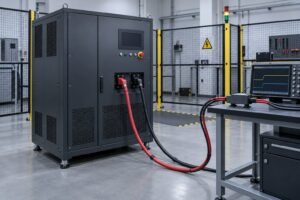
DC power supply ripple measurement on a 360–2250 V bidirectional output uses AC coupling, a defined 20 MHz bandwidth limit, a rated…
Read guide →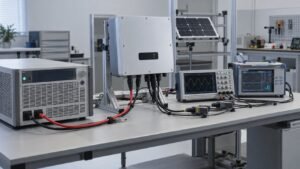
Solar array simulator MPPT testing is defensible when the source enforces a repeatable photovoltaic I-V curve, the wiring follows EN 50530 Clause…
Read guide →
Ultra power solutions for EVSE testing combine a bidirectional DC source and sink with traceable measurements for IEC 61851-23:2023. Your bench should…
Read guide →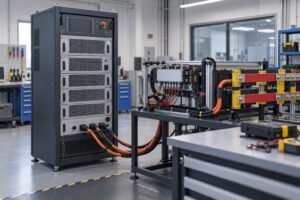
A battery simulator for BMS testing reproduces repeatable cell or pack electrical conditions so you can verify thresholds, balancing, diagnostics and protection…
Read guide →