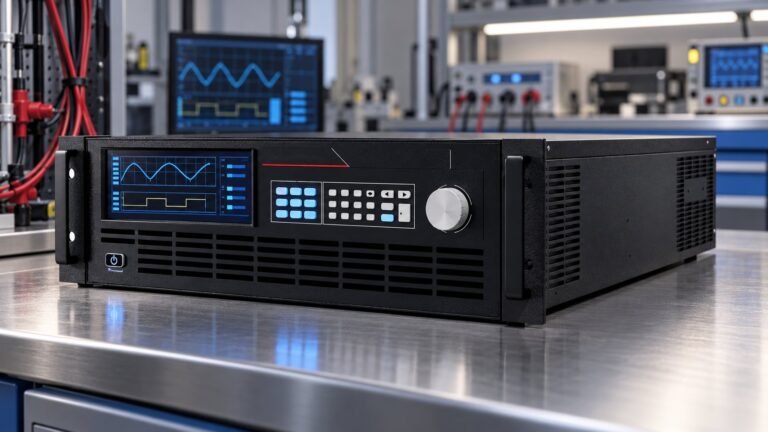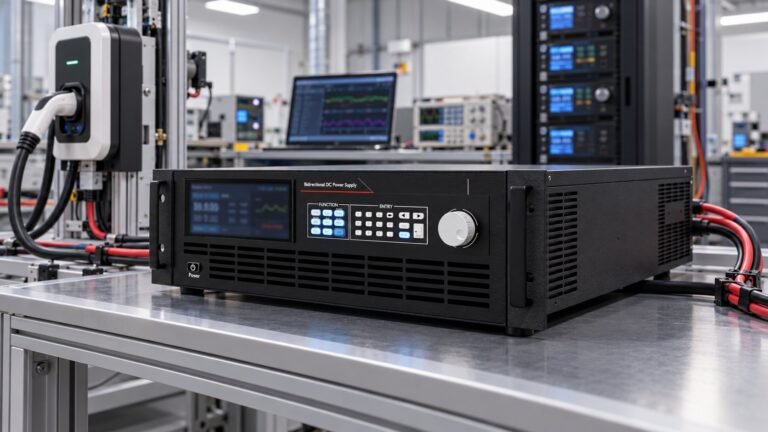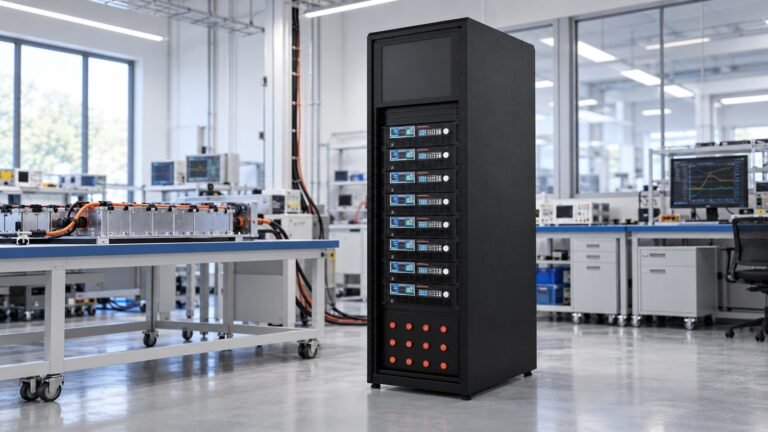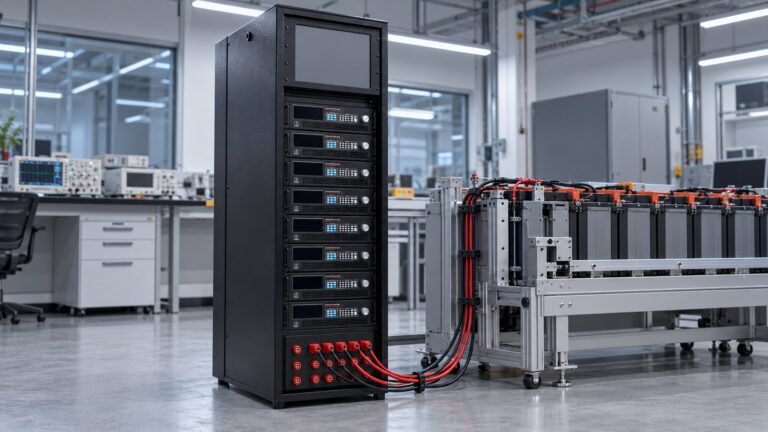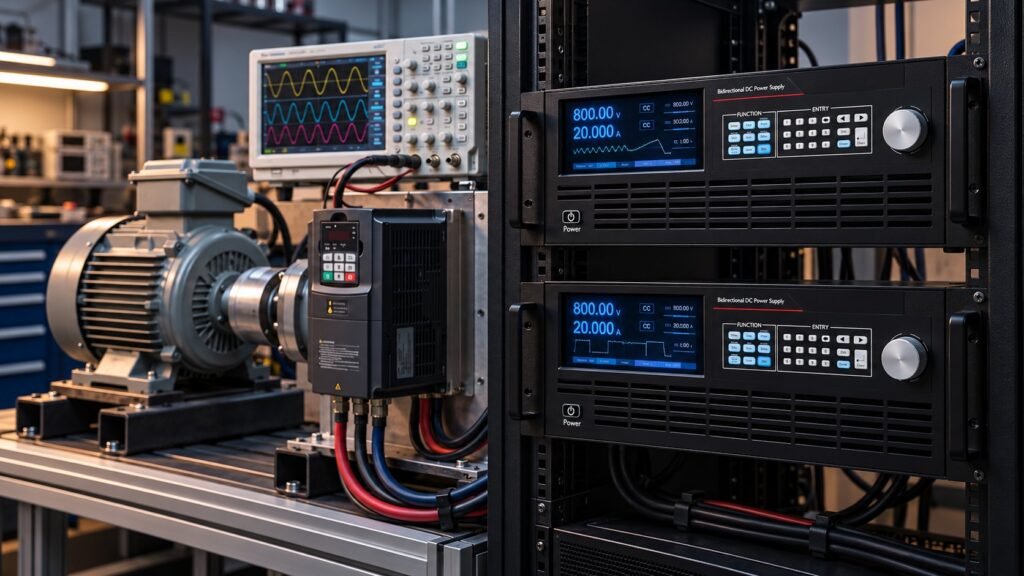
ISO 15118-20 Amendment 1:2026 adds AC DER service, MCS service and an improved security concept. To test it, map Clause 3 states and Clause 7.4 pause events to a bidirectional DC source/sink, then record voltage, current and response time. Your bench validates electrical behaviour; it does not prove protocol conformance.
ISO published the amendment on 13 July 2026. This guide focuses on the missing link between EVCC/SECC messages and measured power behaviour. Ashkan, power supply engineer at Ultra Power Systems, uses a 750 V class bench as the worked example.
What changed in ISO 15118-20 Amendment 1?
ISO 15118-20 Amendment 1 changes three test areas: AC DER service, MCS service and security handling. The ISO record names all three areas. CharIN Testival EUROPE 2026 showed why they now need bench evidence, not only message logs.
| Amendment area | What your test must expose | Use when |
|---|---|---|
| AC DER service | Grid-support setpoints, permission changes and active-power response | Running an AC DER charging test with an EVSE, EV or grid emulator |
| MCS service | Pause, data-link sleep, wake-up and resumed bidirectional energy transfer | Validating MCS bidirectional charging or high-power charging control |
| Improved security concept | TLS 1.3 session setup, EVCC/SECC certificate pairing and rejection of unauthorised peers | Testing a complete EVSE security path before power enable |
CharIN reported that 13 of 23 DC test devices supported bidirectional transfer, while 7 of 11 AC devices supported AC bidirectional transfer or AC DER functions. The same event recorded MCS compatibility and line-lock reliability issues. Those results support a measured pause-and-resume test at your own voltage and current class.
Which Clause 3 states should your bench expose?
Clause 3.72–3.74 gives your test software three useful labels: charge-enable state, MCS and cease-to-energize. Log each label beside the DC waveform so a protocol event can be checked against actual current flow.
| Clause | State | Bench event and pass condition |
|---|---|---|
| 3.72 | Charge-enable state | Assert CE before energy transfer; apply a lab limit such as less than 0.5 A before enable |
| 3.73 | Megawatt charging system | Identify MCS or MCS_BPT, then run the selected voltage and current profile |
| 3.74 | Cease to energize | After the stop or pause command, current falls to the defined zero-current limit while voltage remains controlled |
Use the Clause 3 labels as trace metadata. Do not treat them as a replacement for the EVCC and SECC state machine. A trace that shows 0 A without proving the correct message sequence is an electrical result, not ISO 15118-20 testing.
How do you test MCS pause and data-link wake-up?
The published amendment adds two Clause 7.4 requirements for MCS and MCS_BPT. V2G20-3006 places the EVCC pause after SessionStopRes with ResponseCode OK. V2G20-3007 places the SECC pause after it sends that response.
- Pair the EVCC and SECC under TLS 1.3 and record certificate status. Failure mode: an unpaired or invalid peer reaches a power-enabled session.
- Start an MCS_BPT session at 750 V and +20 A source current. Record voltage, current and CE state at 100 kS/s. Failure mode: current rises before CE is asserted.
- Send SessionStopReq with ChargingSession set to Pause. Capture SessionStopRes with ResponseCode OK. Failure mode: either controller pauses before the required response.
- Apply D-LINK_PAUSE.request() and verify that current reaches the zero-current limit without an uncontrolled voltage collapse. Failure mode: stale current remains above 0.5 A after the pause.
- Complete the data-link wake-up, resume the session and repeat at -20 A sink current. Failure mode: the link wakes but the source/sink remains in the wrong power direction.
- Replace the trusted EVCC certificate with an unpaired certificate. The SECC must reject the session and the DC stage must remain below 0.5 A. Failure mode: unauthorised energy transfer.
Once the pause and wake sequence passes, the next check is export safety and grid-facing power behaviour. Use UL 9741 Testing for V2G Power Export when your test plan moves from protocol response to power-export requirements.
What should your DC source/sink measure?
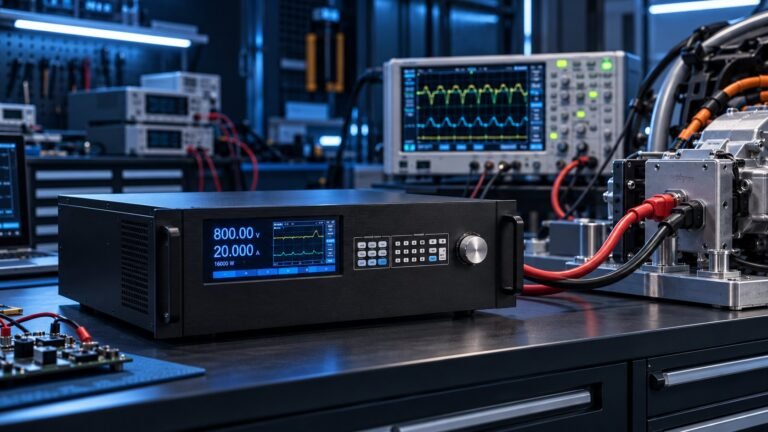
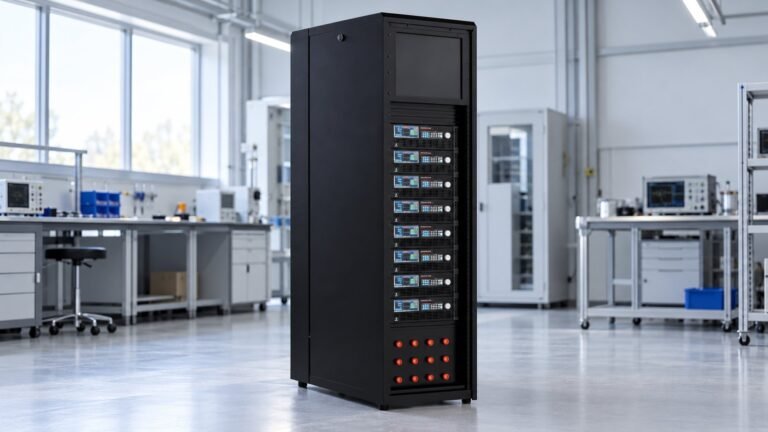
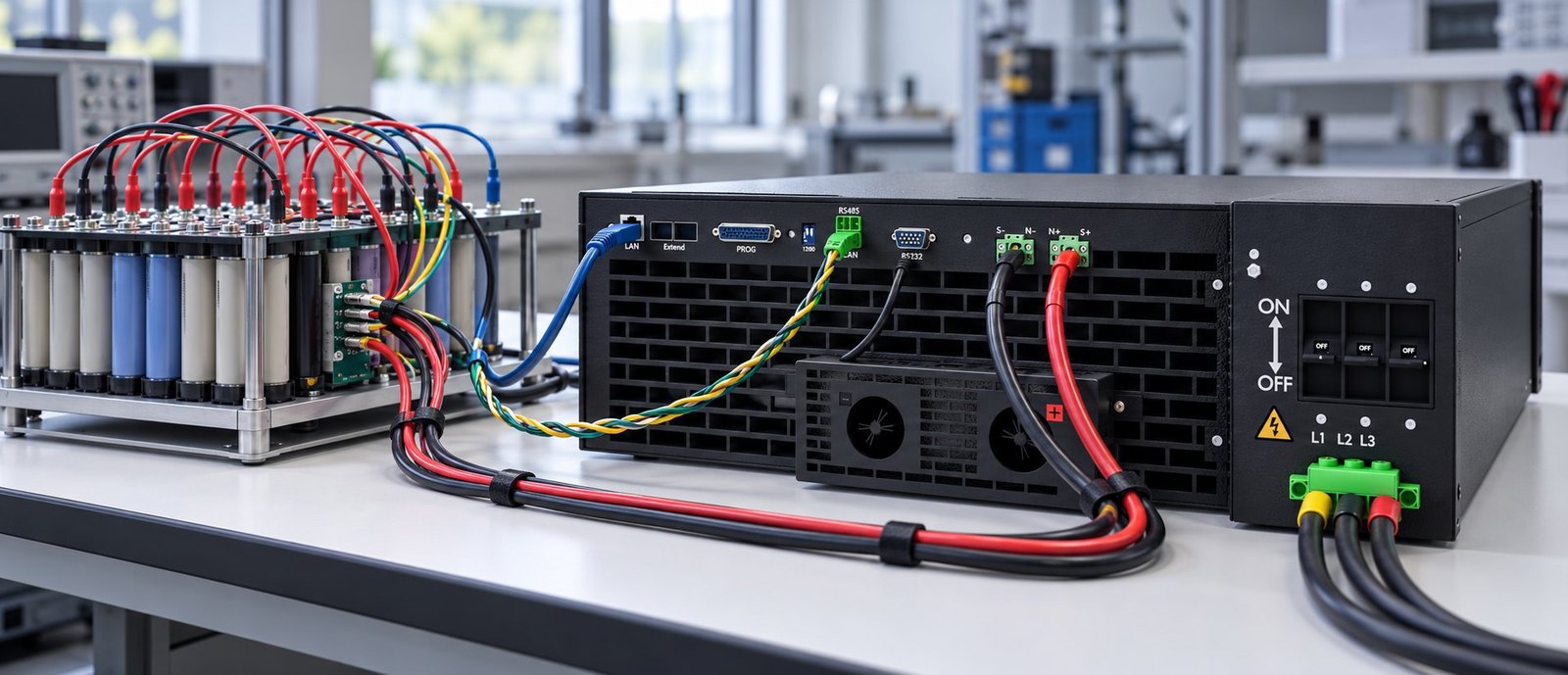
A DC source/sink should measure commanded voltage, source current, sink current, transient response and the time between protocol events. Ultra Power Systems supplies cover 360 V, 750 V, 1500 V and 2250 V classes; the example below uses 750 V and ±20 A.
Example Ultra Power Systems bench record
Ashkan’s bench record uses 100 kS/s sampling, a 10 microsecond sample interval and a 750 V DC bus. The measured current fall from 20 A to 0.2 A takes 2.0 ms. Peak voltage deviation is 1.2 V, with the bus settling inside 0.5 V in 4.0 ms.
| Time after command | Command or state | Measured voltage | Measured current |
|---|---|---|---|
| 0 ms | SessionStopReq Pause sent | 750.0 V | +20.0 A |
| 2 ms | SessionStopRes OK | 750.7 V | +8.4 A |
| 4 ms | D-LINK_PAUSE.request() | 751.2 V | +0.2 A |
| 20 ms | Pause settled | 750.6 V | 0.0 A |
| 620 ms | Data-link wake complete | 750.1 V | 0.0 A |
| 640 ms | Energy transfer resumed | 749.8 V | +19.8 A |
| 900 ms | Reverse setpoint applied | 749.6 V | -19.7 A |
This trace is the evidence you need after each command. If your test uses an AC-to-DC regenerative stage, document its commissioning separately with an ac dc regenerative converter procedure.
How do you separate protocol and electrical conformance?
A DC source/sink validates electrical behaviour. It does not replace protocol conformance testing. Keep the two result sets separate, then correlate them by timestamp, session ID and command name.
- Protocol result: TLS 1.3 negotiation, EVCC/SECC pairing, message order and response codes.
- Electrical result: voltage regulation, source current, sink current, overshoot, settling time and cease-to-energize response.
- AC DER result: active-power or reactive-power command response through the EVSE and grid emulator.
- MCS result: pause timing, data-link wake-up, connector lock status and resumed power direction.
- Failure result: the exact trigger, such as current above 0.5 A after pause or energy transfer after certificate rejection.
QualityLogic’s Implementing Interoperable V2G-AC is useful context for the AC control path. Your DC bench remains the place to prove how a commanded state affects real voltage and current. That separation prevents a passing message trace from hiding an unsafe power response.
ISO 15118-20 Amendment 1 FAQ
What does ISO 15118-20 Amendment 1 add?
It adds AC DER service, MCS service and an improved security concept to ISO 15118-20:2022. The ISO record lists the amendment as published in July 2026.
What are V2G20-3006 and V2G20-3007?
They are Clause 7.4 MCS requirements for pausing the data link after a successful SessionStop response. V2G20-3006 applies to the EVCC. V2G20-3007 applies to the SECC.
Can a bidirectional DC supply prove ISO conformance?
No. It proves the electrical response to protocol commands. You still need protocol conformance tests for message order, security, state handling and interoperability.
Which voltage class should you choose?
Choose the class that matches your EV or EVSE: 360 V for lower-voltage platforms, 750 V for common high-voltage benches, 1500 V for heavy-duty systems and 2250 V for higher-voltage development.
Build the measured test around the amendment
ISO 15118-20 Amendment 1 becomes actionable when Clause 3 states, Clause 7.4 events, TLS 1.3 pairing and DC waveforms share one trace. Specify the voltage class, ±20 A or higher current range, 100 kS/s logging and a defined zero-current limit. For a controlled 12 V DC power source range and bidirectional test hardware, review the available UltraPower systems →