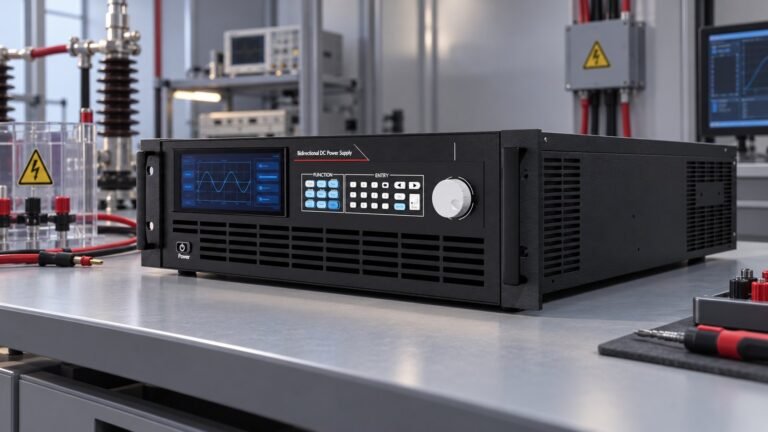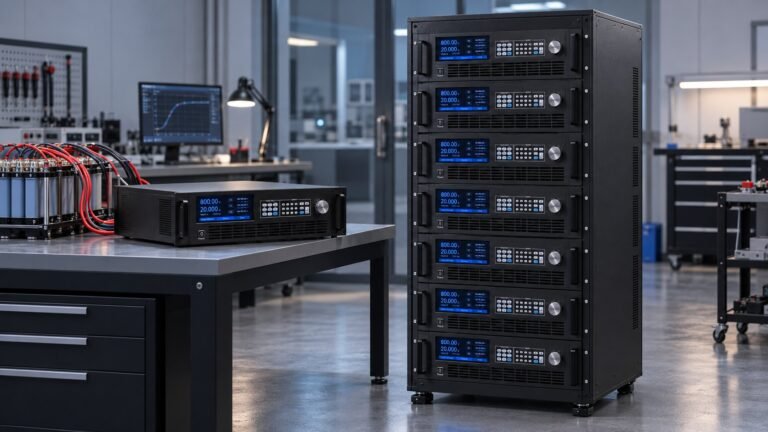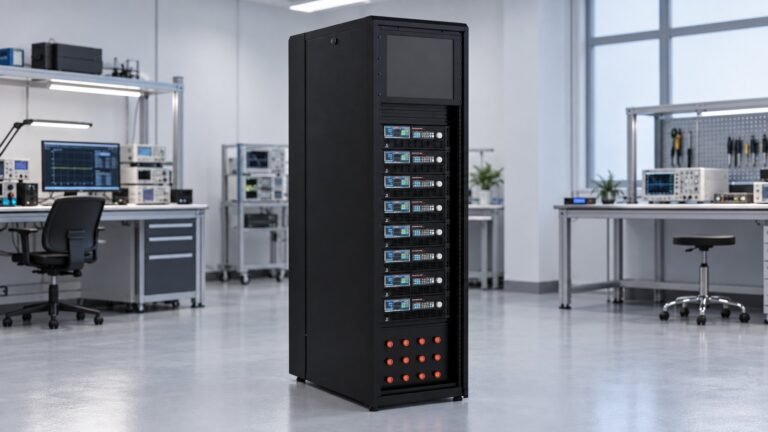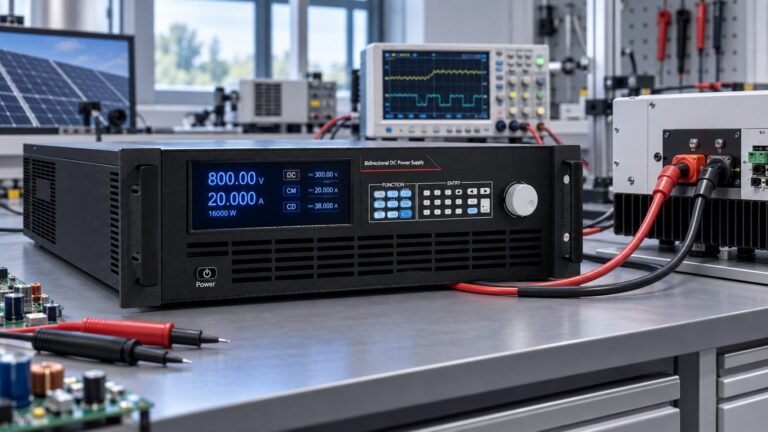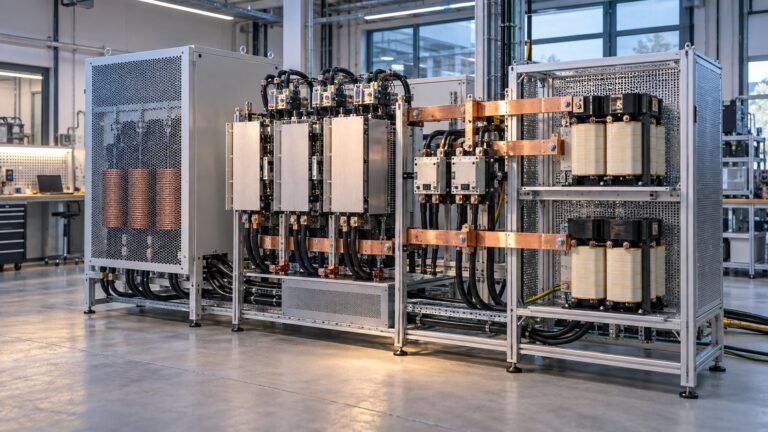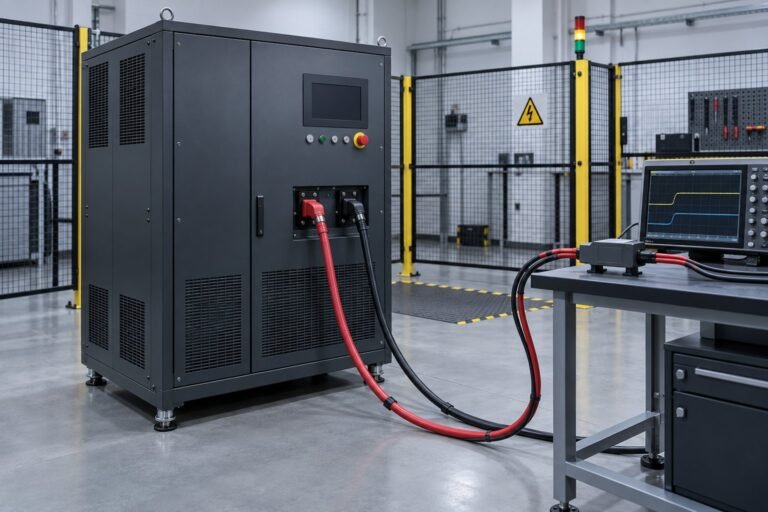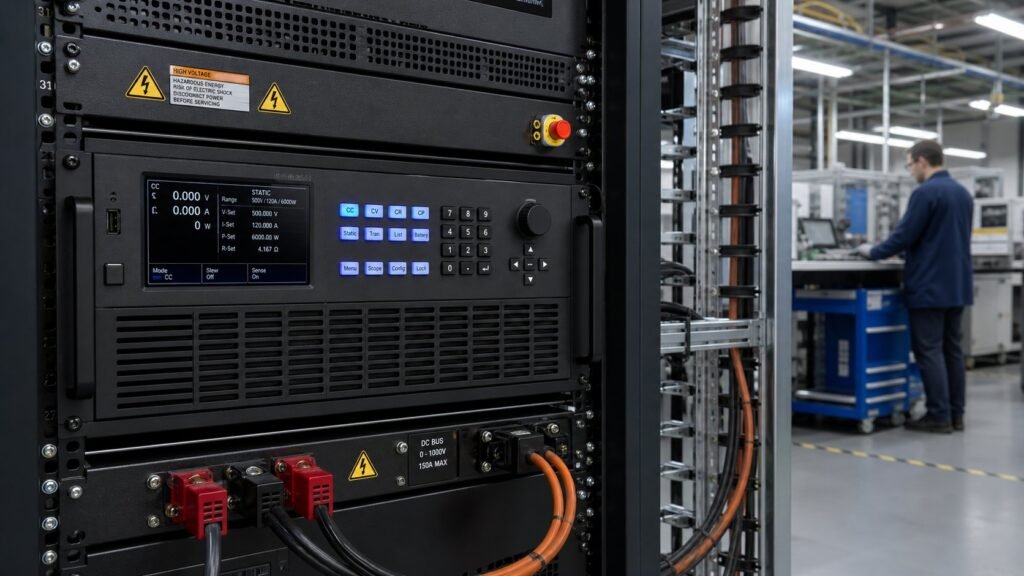
A regenerative dc electronic load sinks the output of the supply under test. It pushes the recovered energy back onto the AC line. That beats burning it as heat across resistor banks. This one choice shapes your whole high-power dc power supply testing programme. Get it wrong, and you need a chiller upgrade. Get it right, and you see a credit on the power bill.
One of the clearest cases is high-voltage bias for RF amplifiers. These supplies stack dozens of series-connected dc-dc modules to reach tens of kilovolts. Every module needs proving at full current, for hours, before it ships. Here’s what that test looks like on a real bench, and what to specify when you build one.
What a Regenerative DC Electronic Load Does
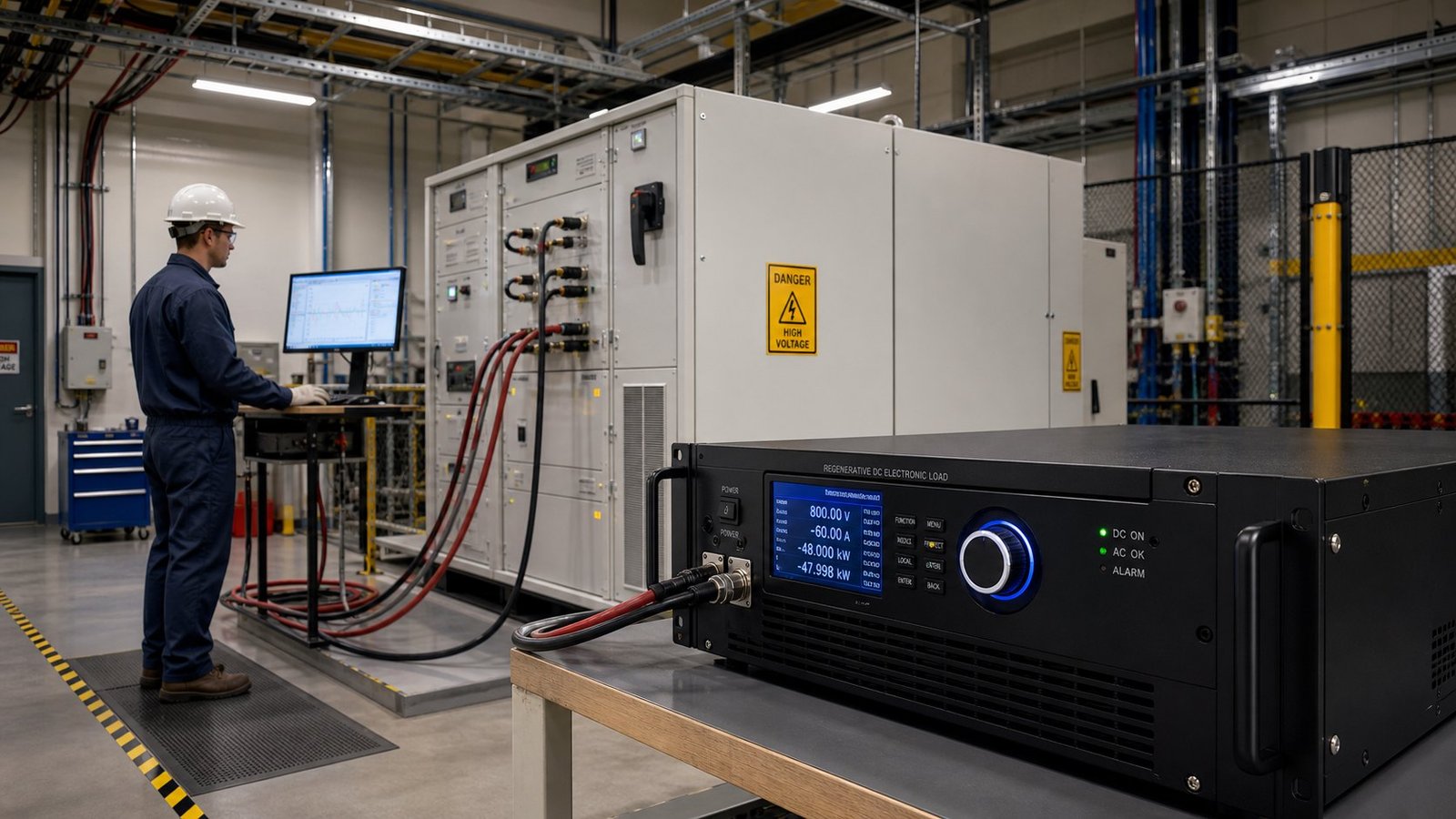
A resistive load bank dissipates every watt as heat. At tens of kilowatts, that means fans, ducting, and an HVAC bill that grows with your test schedule. A regenerative load instead rectifies and inverts the sunk power back to the grid. It typically recovers 90% or more of it. You still get the same CV, CC, and CR test modes. You just lose the thermal load in your test cell.
That matters most when the unit under test is itself a high-power DC power supply. Burn-in, acceptance testing, and life testing all run near full rated current for hours at a time. Build your energy recovery test bench around a regenerative load, and that current becomes useful energy, not wasted heat. It also cuts your site’s cooling and power infrastructure costs.
See also: Automating a DC Power Supply with SCPI, Modbus & CANopen
Inside a 36 kV RF Bias Supply — A Real Test Case
Consider a modular 36 kV, 24 A dc power supply built for RF amplifier bias. It’s the kind used in radar and broadcast transmitters. A three-phase 11 kV input feeds a 24-pulsed rectifier, creating a 750 V dc bus. That bus feeds 72 series-connected 500 V, 24 A dc-dc converters. Eight modules are held back as active redundancy. If one fails, the rest pick up its share automatically.
Proving a supply like this needs test gear rated for the same duty cycle it sees in the field. At full redundancy loss, that duty cycle is 88.23%, per the published design data. A bidirectional dc power supply test bench pairs with a regenerative load. Together, they push the unit to its full 36 kV, 24 A rating. They hold it there for a complete burn-in run. The published design held ≥0.97 input power factor, ≤6% current THD, ≤0.25% output ripple, and ≤0.4% output voltage stability. You can only confirm figures like that under real, sustained load.
See also: bidirectional high-capacity dc power supply
Redundancy and Duty-Cycle Testing
Active redundancy changes how you test. When a module fails, the healthy modules take over automatically. They shift duty cycle to hold the output voltage steady. A regenerative load lets you simulate that shift under real current, not just in simulation. That’s the only way to catch timing or thermal issues before they reach the field.
When you specify a bench for a modular, redundant high-power DC supply, check for:
- Full-current CC mode matching the supply’s rated output — 24 A up to 36 kV in this example
- Fast transient response, to catch voltage steps when a module drops out or a redundant one engages
- Regeneration efficiency above 90%, so long burn-in runs don’t overload your site’s power and cooling
- Ripple, THD, and power factor logging across the full duty-cycle range, not just at one operating point
Choosing a Regenerative DC Electronic Load for Your Bench
Match the load’s voltage and current class to your supply, with headroom for transient overshoot. Ultra Power Systems builds bidirectional supplies across the 360 V to 2250 V range. You can test everything from a single 500 V converter module to a full 36 kV stack, in sections. Our regenerative DC load range shares that same voltage coverage.
Look for a load with independent CV, CC, and CR modes. That lets you profile the supply the way its RF load actually behaves. For wider context on where this fits, see our Applications page. Or pull full specs from Downloads & Datasheets before you spec a bench.
FAQ: Regenerative DC Load Testing
How much energy does a regenerative load recover?
Most systems recover 90% or more of the sunk power. They feed it back to the AC line, instead of dissipating it as heat. That cuts both your energy bill and your cooling load during long burn-in runs.
Can one load test a 36 kV modular supply on its own?
Not usually, at full voltage in one shot. In practice, you test dc-dc converter modules individually, or in short series strings. Then you validate the full stack’s redundancy and ripple behaviour at system level.
Which test modes matter most for RF bias supply validation?
CC mode matters most, for burn-in at rated current. Add fast transient steps that mimic a module dropping out, or a redundant module engaging. Ripple and THD logging across the full duty-cycle range matter just as much.
Put a Regenerative DC Electronic Load on Your Test Floor
Whether you’re proving a single 500 V dc-dc converter or a full 36 kV RF bias stack, one thing stays true. The right regenerative load turns your test floor into an energy recovery test bench, not a heat problem. Browse our regenerative DC load range →. Match a bidirectional load to your supply’s voltage class before your next burn-in run.