IEC 62475 2026 turns a high-voltage FAT into a measurement-system acceptance test. You verify the external current reference, DUT-terminal voltage, uncertainty, linearity, transient response and stability at defined source and sink points. A programmed setpoint passes only when the traceable chain proves the result within its stated limit.
EVS-EN IEC 62475:2026 is valid from 1 October 2026. Ashkan, power supply engineer at Ultra Power Systems, applies the edition to bidirectional and regenerative DC benches from 360 V to 2250 V. The aim is a recorded FAT decision, not a standards summary.
What should your IEC 62475 2026 FAT prove?
Your FAT should prove that the complete measurement chain supports the claimed voltage and current result. The IEC 62475:2026 publication says the second edition cancels the 2010 edition, generally addresses currents above 100 A, aligns terminology with IEC 60060-2:2025 and adds an uncertainty example in Annex B, Clause B.4.
Convert those points into three controlled records: an uncertainty budget, the Clause 5.2 performance checks and a signed performance record. Do not use the controller display as independent evidence of current accuracy.
How should Clause 4.6 shape your uncertainty budget?
Clause 4.6 should become a signed uncertainty budget for the installed test arrangement. Record each material contribution, the coverage factor, the combined result and expanded uncertainty in amperes and percentage at every acceptance point.
| Measurement contribution | Record | Decision use |
|---|---|---|
| External shunt or current transducer | Range, certificate, scale factor, drift and expanded uncertainty | Every current point |
| Four-wire voltage sensing | Sense location, lead resistance and DUT-terminal voltage | Cable runs above 1 m or currents above 100 A |
| Bandwidth and sampling | Analogue bandwidth, sample rate, resolution and timestamps | Steps, ramps and settling tests |
| Cable and connection drop | Measured drop in volts at current and temperature | Source and regenerative load paths |
| Combined result | Sensitivity coefficients, coverage factor and final percentage | FAT approval |
For high-current measurement uncertainty, keep the reference instrument outside the supply control loop. Use a traceable shunt or current transducer for an independent comparison. Base the uncertainty statement on the actual wiring, range and temperature used during the test.
See also: lv123 standard
How do you test Clause 5.2 on a source/sink bench?
Clause 5.2 requires more than one accuracy number. Test calibration and scale factor, linearity, dynamic behaviour and short-term stability, then attach the required performance record to the FAT.
Use a five-step acceptance sequence
- Apply traceable zero and span points to the external current and voltage references. Failure mode: the setpoint passes while a scale-factor error remains across the range.
- Test low, mid and high current, including a point above 100 A where the bench is intended to operate. Failure mode: linearity passes at 20 A but exceeds the uncertainty budget at 250 A.
- Command a defined current step in both source and sink directions. Failure mode: the measuring chain misses a current transient because bandwidth or sampling is too low.
- Hold each operating point for the specified dwell time and calculate short-term variation. Failure mode: thermal drift or control-loop hunting appears after the first stable reading.
- Attach raw readings, certificates, wiring details, calculations and pass/fail decisions. Failure mode: a compliant result cannot be reproduced during site acceptance.
If energy return is included, align the transient record with the ac dc regenerative converter commissioning method so source and sink measurements share one time base.
Which bench hardware controls the acceptance result?
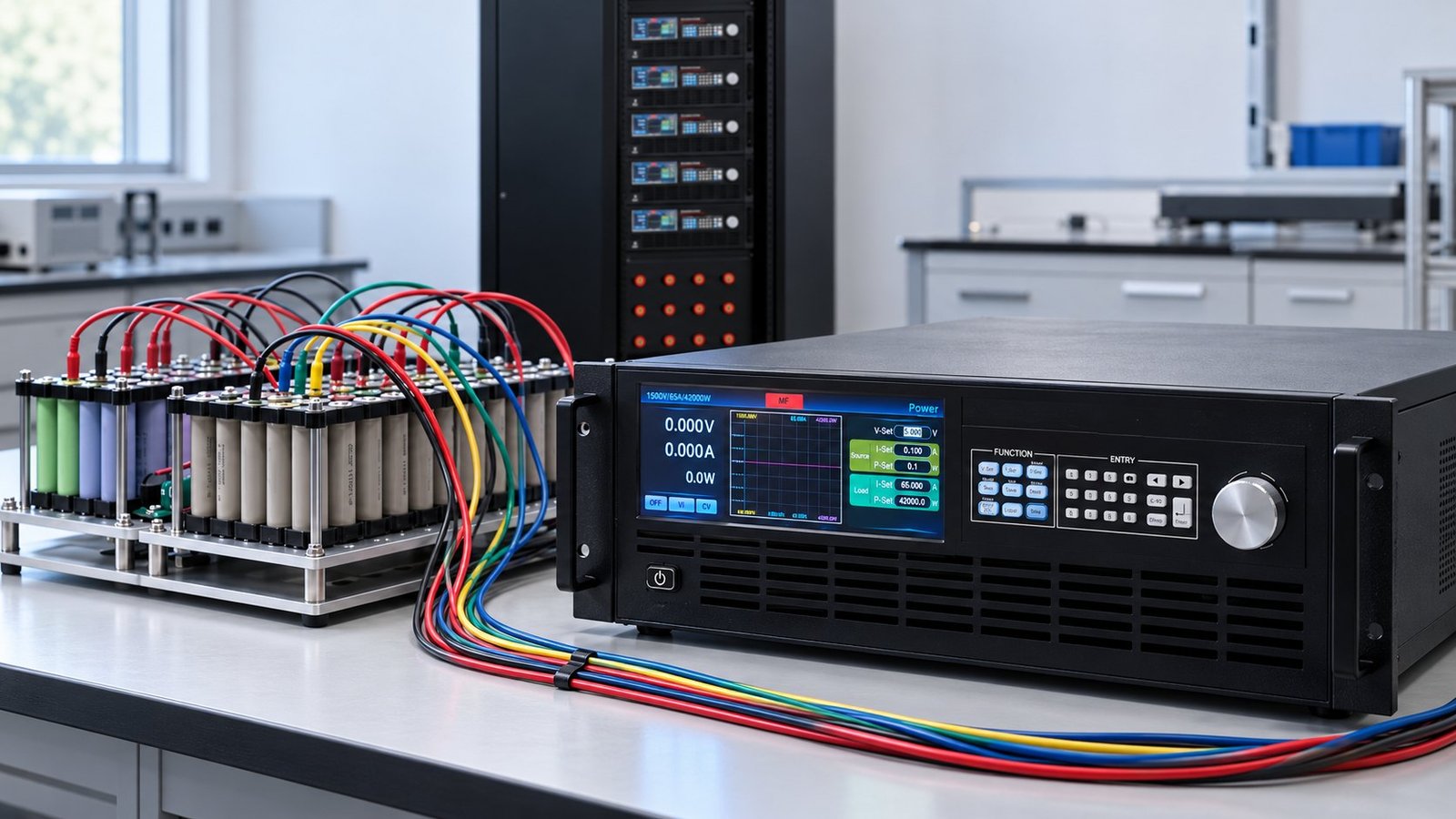
A defensible bench measures voltage at the DUT terminals, current through an independent reference and transients with sufficient bandwidth and sampling margin. Cable drop and calibration traceability must remain visible in the FAT record.
| Bench element | Acceptance decision | Practical requirement |
|---|---|---|
| External current reference | Independent current comparison | Traceable shunt or transducer with stated range and uncertainty |
| Voltage measurement | Correct DUT-terminal voltage | Four-wire sensing with recorded sense-point location |
| Transient capture | Measured response | Defined bandwidth and sample rate before the step |
| High-current path | Known delivered voltage | Cable-drop measurement at acceptance current and temperature |
| Calibration record | Reproducible result | Certificates, dates, ranges and scale-factor calculations linked to the FAT |
Example operating point and failure trigger
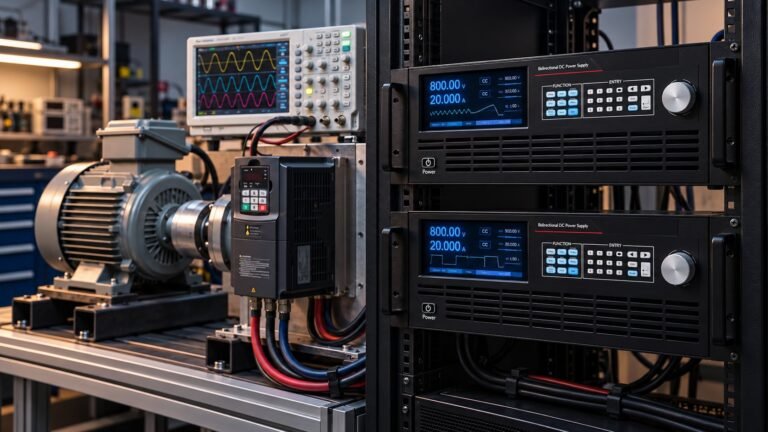
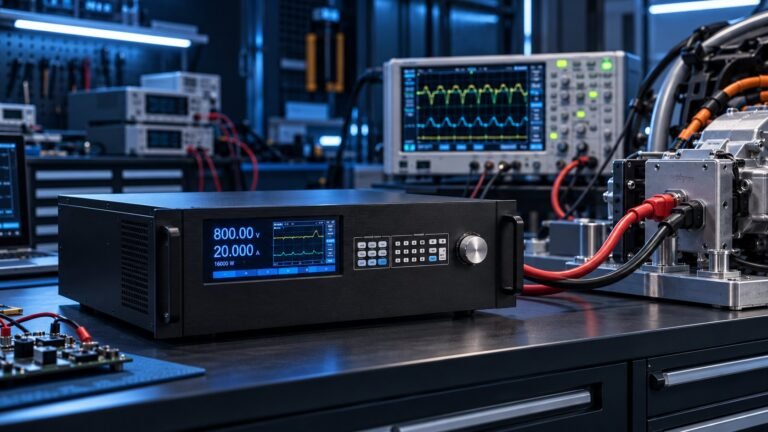
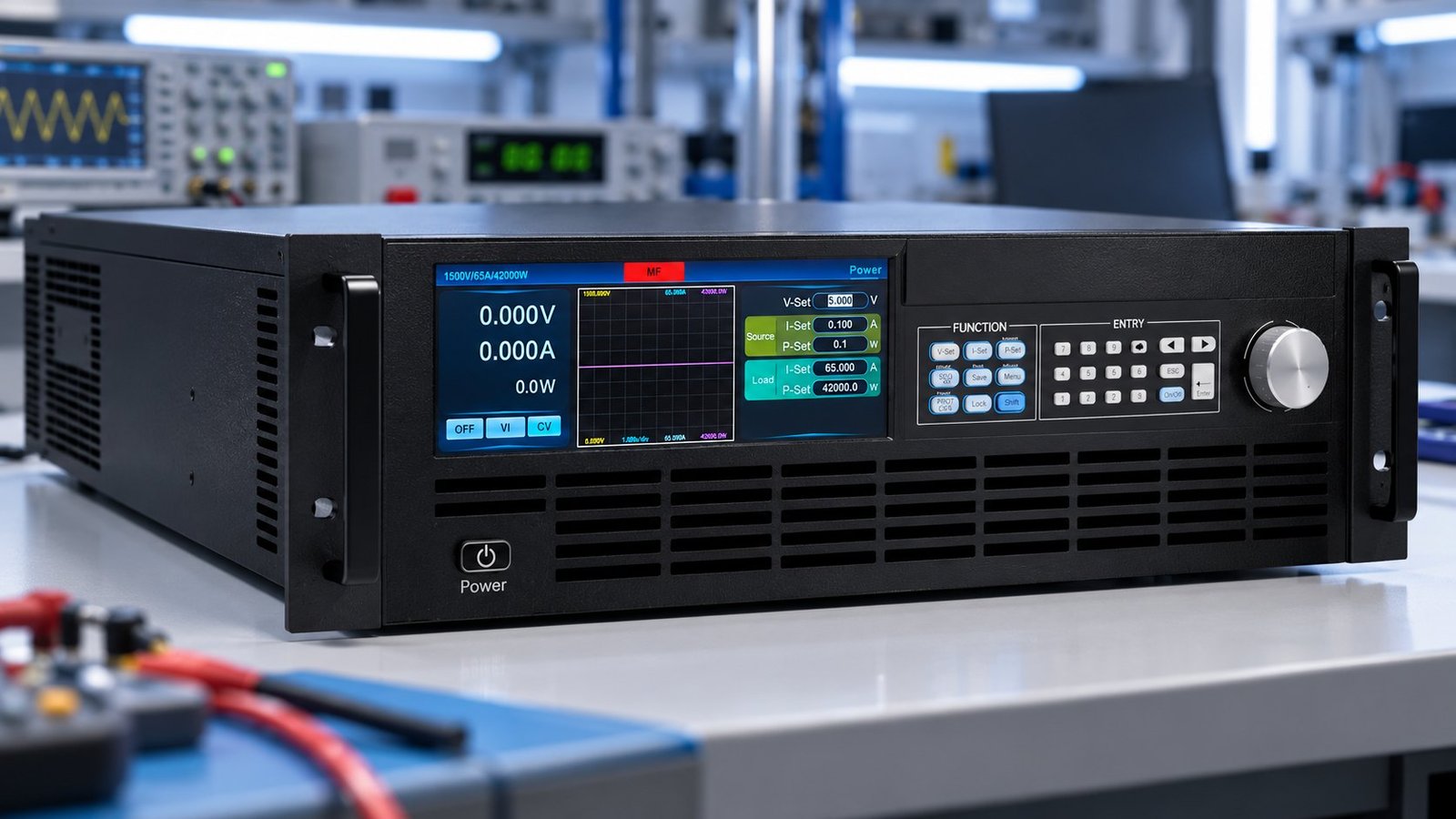
For the Ultra Power Systems 1500 V / 65 A / 42 kW cabinet configuration, one recorded operating point is 800.00 V and 20.000 A. The measured result carries an expanded uncertainty of ±0.100 A, or 0.50%, with an 8 ms settling time. The setpoint can pass while the measuring chain misses a current transient or exceeds the uncertainty budget.
Use the High Voltage DC Power Supply Selection Guide before fixing the matrix if your source, sink or cable architecture changes between 360 V, 750 V, 1500 V and 2250 V classes.
What should the final FAT record contain?
The final record should let another engineer reproduce the result without asking which instrument, cable path or calculation method was used. Set limits before testing and record the trigger for every failure.
- Operating voltage, current, direction and power at every test point.
- Reference shunt or current-transducer identification, range and traceability date.
- Expanded uncertainty in A and %, with coverage factor and calculation file.
- Four-wire voltage-sense location and measured cable drop in V.
- Bandwidth, sampling rate, transient definition and settling-time method.
- Calibration, scale factor, linearity, dynamic behaviour and short-term stability results.
- Raw data, certificates, environmental conditions and authorised sign-off.
See also: UL 9741 Testing for V2G Power Export
FAT questions buyers ask about the 2026 edition
Does IEC 62475:2026 replace the 2010 edition?
Yes. The IEC 62475:2026 publication identifies the document as the second edition and states that it cancels and replaces the 2010 edition.
Is the measurement approach only relevant above 100 A?
No. The publication generally addresses currents above 100 A, but the same uncertainty and transient controls remain useful wherever current accuracy affects acceptance.
Why does IEC 60060-2:2025 appear in the FAT plan?
IEC 62475:2026 aligns its terminology with IEC 60060-2:2025. Use the aligned terms in calibration records, uncertainty calculations and measurement-point definitions.
What does DC test bench calibration prove?
DC test bench calibration proves that the installed reference chain measures the voltage and current claimed at the DUT terminals, including scale factor, linearity, drift and cable effects.
Turn the standard into an acceptance decision
Build the FAT around Clause 4.6 uncertainty, Clause 5.2 performance checks and the Annex B.4 example, then tie each result to the actual source/sink wiring. Specify the operating points, references and failure triggers before ordering your next ac and dc converter systems →