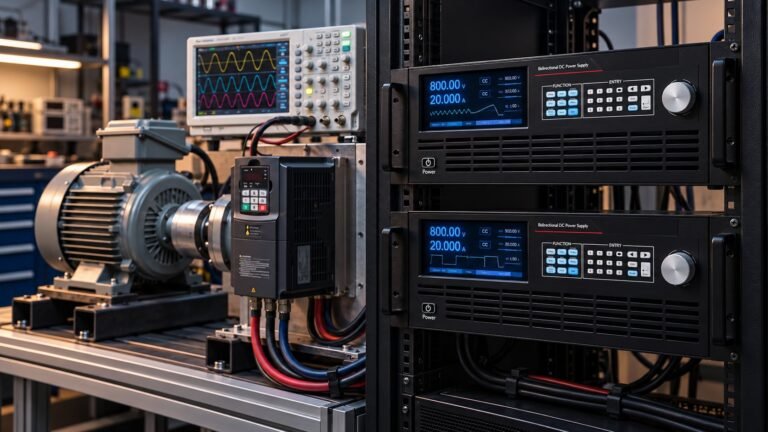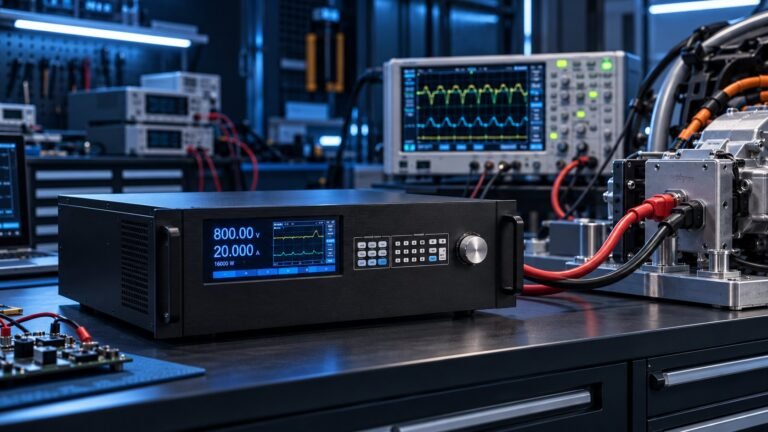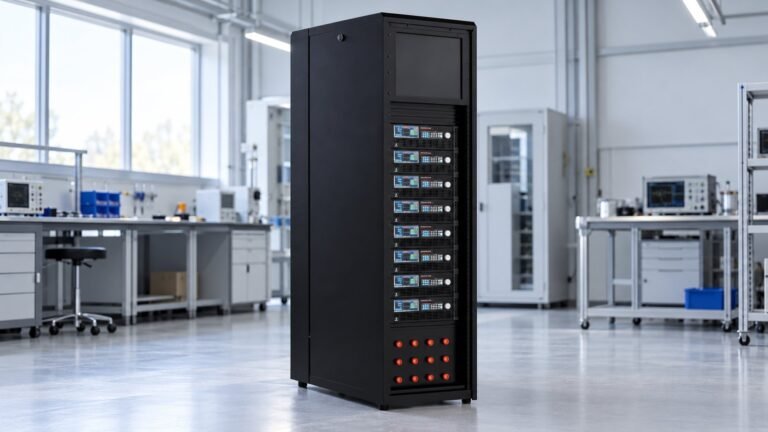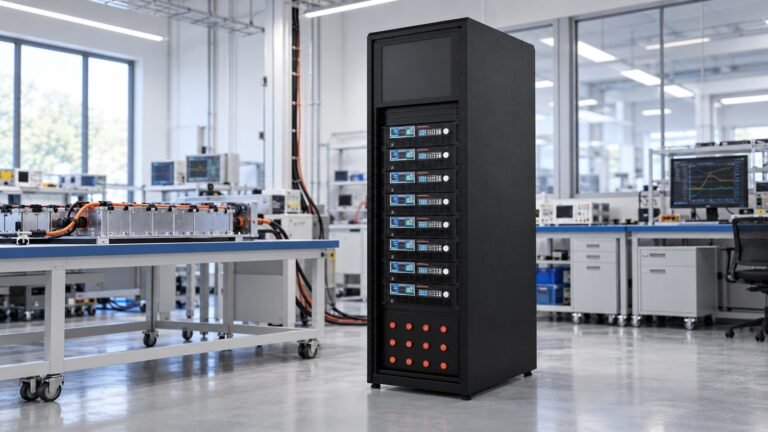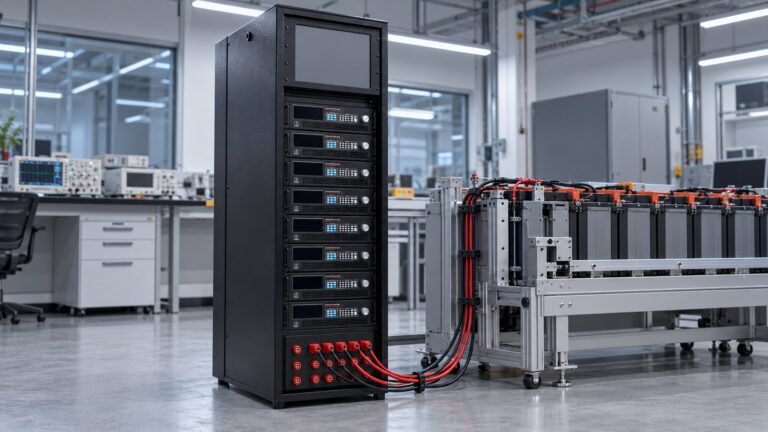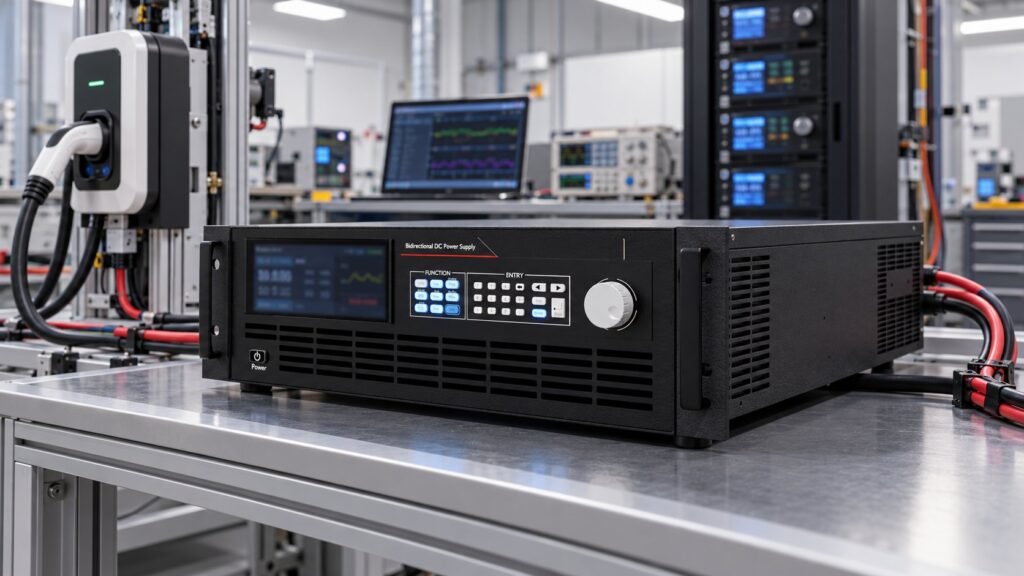
A regenerative dc bidirectional source validates EVSE by driving the DC bus forward, absorbing reverse power, and recording current accuracy, ripple, transition, overshoot and shutdown against IEC 61851-23:2023. Specify the voltage class, signed current limit, firmware, measurement bandwidth and pass/fail thresholds before connecting the EVSE.
This guide maps the standard to an actual source-sink sequence instead of a product listing. I am Ashkan, power supply engineer at Ultra Power Systems. IEC’s 2026 stability date makes forward and reverse evidence a lab release gate. ReGridWeek 2026 also reports that the DC load can change charger behaviour and increase ripple.
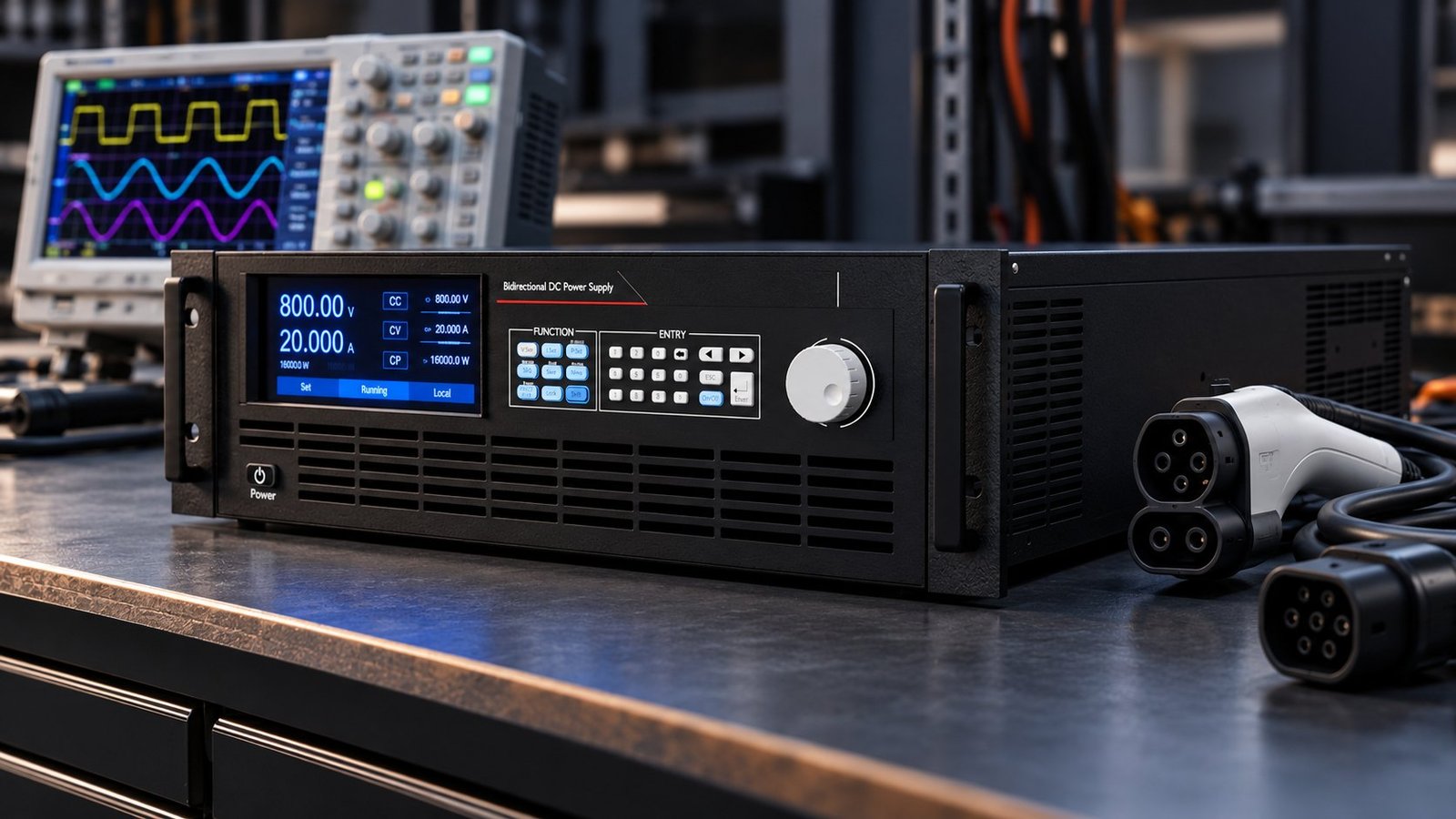
Why does IEC 61851-23:2023 matter now?
IEC 61851-23:2023 matters because it adds clearer compliance and bidirectional-transfer evidence to DC EVSE validation. The IEC lists a 2026 stability date, so your test plan should now reflect Edition 2 requirements rather than relying on the 2014 workflow.
The scope reaches 1,000 V AC or 1,500 V DC on side A and 1,500 V DC on side B. IEC revised electrical safety requirements in Clauses 8 and 12, added general compliance provisions in Clause 102, and added bidirectional power-transfer guidance in Annex DD. System A BPT is addressed; RPT and BPT requirements for systems B and C remain under consideration.
See also: 12v dc power supply
How do you specify a regenerative dc bidirectional source?
Specify the source by voltage class, signed current, transition behaviour, ripple bandwidth and shutdown response. Ultra Power’s bidirectional and regenerative range covers 360 V to 2250 V classes, so select the class above the EVSE side-B maximum and then verify current at the required power.
For voltage-class decisions, use the High Voltage DC Power Supply Selection Guide. For topology decisions, compare the Regenerative Load vs Electronic Load: Key Differences before freezing your bench design.
DEKRA’s March 2024 summary provides practical acceptance values for the worksheet below. Tie every result to the licensed IEC edition, system type and applicable clause.
| Test item | Acceptance evidence | Use when |
|---|---|---|
| Target-current accuracy | ±2.5 A below 50 A; ±5% at 50 A or more | Checking EVSE current regulation during charge and RPT transitions |
| Current ripple | 1.5 A peak-to-peak below 10 Hz; 6 A at 5 kHz; 9 A at 150 kHz | Sweeping operating points and reporting bandwidth-specific results |
| Emergency shutdown | Current falls below 5 A within the applicable time limit | Testing pilot loss, protection trips and commanded shutdown |
| Reverse operation | Signed current changes direction without sink dropout or unsafe bus rise | Running IEC 61851-23 bidirectional power transfer tests |
How should EVSE source-sink testing run?
EVSE source sink testing should move from a controlled forward-power point into reverse power transfer, then test limits and shutdown under the same measurement chain. Record the command, present current, bus voltage and protection state at every step.
- Set the source to the EVSE’s nominal DC bus, connect isolated voltage and current probes, and log firmware and bandwidth. Failure mode: an undocumented filter hides switching ripple.
- Run forward power at 400 V and 40 A, then step to the rated current region. Failure mode: current error exceeds the DEKRA tolerance or the EVSE derates unexpectedly.
- Command a controlled current reduction before changing polarity. Failure mode: the EVSE opens its contactors while current remains above the shutdown threshold.
- Enable RPT with a defined sink limit and step from +40 A to −40 A. Failure mode: the RPT current-limit change causes sink dropout or DC-bus overshoot.
- Trigger emergency shutdown and measure the time to below 5 A. Failure mode: the source remains above the limit long enough to stress the EVSE contactors or protection circuit.
Use a regenerative dc electronic load when the absorber must return energy to the facility supply. The absorber’s control loop, cable inductance and filter are part of the test environment, not invisible accessories.
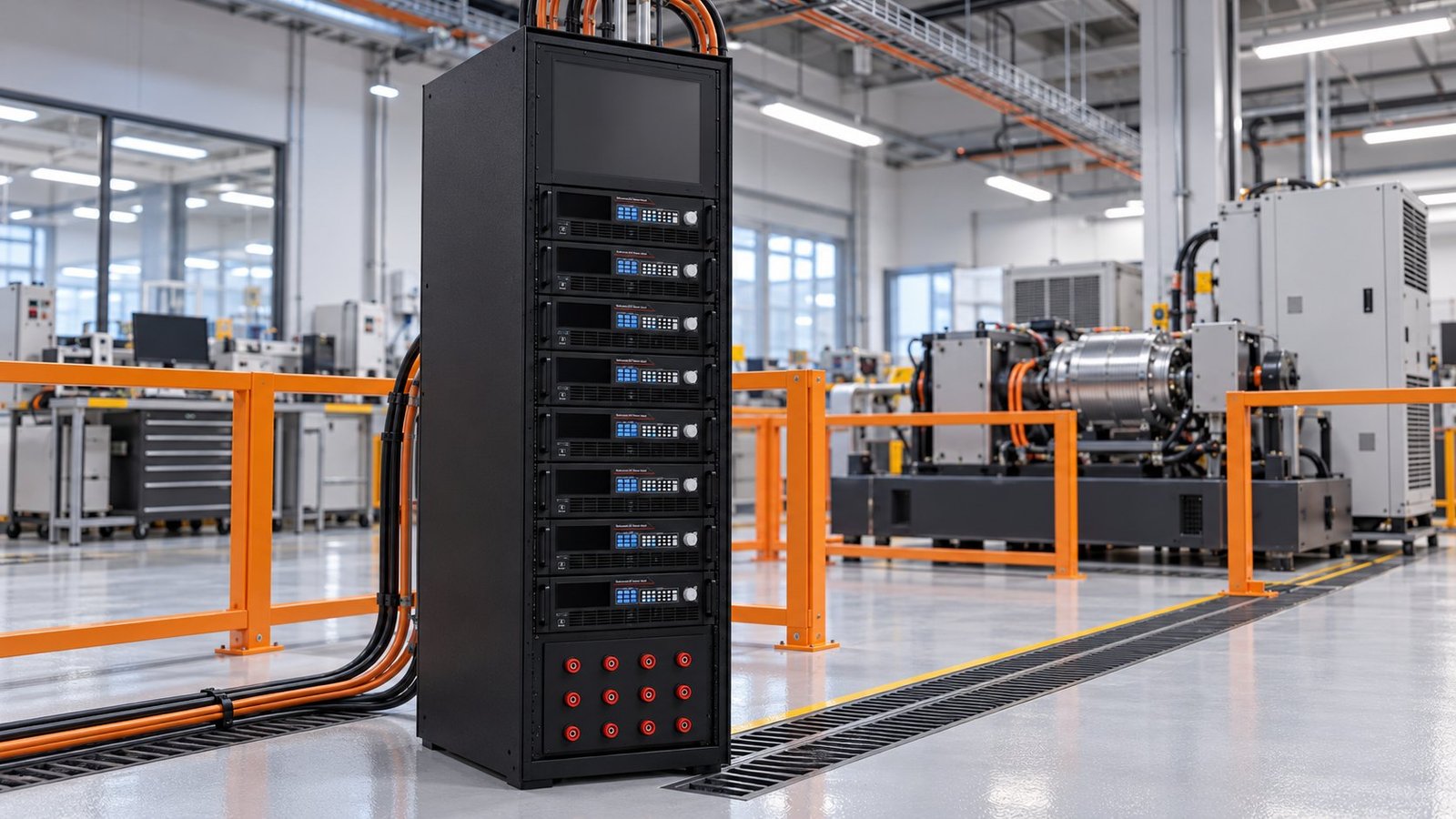
What must a real RPT test bench trace report?
A real RPT test bench trace must identify the source model, voltage class, current limit, firmware and measurement bandwidth before showing results. The trace must report transition time in milliseconds, voltage overshoot in volts, ripple in millivolts peak-to-peak and shutdown time.
| Trace field | Ultra Power bench record | Pass/fail use |
|---|---|---|
| Source model and class | RBS20K-500, 500 V class, ±80 A current limit | Confirms the hardware envelope |
| Control firmware | FW 1.0.3 | Makes the result repeatable after software changes |
| Measurement bandwidth | 100 kHz oscilloscope bandwidth limit | Defines the reported ripple window |
| Forward-to-RPT transition | 14.6 ms | Checks signed-current handover |
| Voltage overshoot | 3.8 V at a 400 V bus | Checks bus stability during sink takeover |
| DC-bus ripple | 420 mV peak-to-peak | Separates bench-induced ripple from EVSE behaviour |
| Emergency shutdown | 26 ms to below 5 A | Checks the applicable shutdown requirement |
Treat the trace as a release record, not a screenshot. ReGridWeek 2026 identifies higher DC-side ripple when the load representation and its power electronics influence the charger. Repeat the trace with the RPT limit changed by 10 A; a dropout or bus overshoot after that change is a bench interaction that must be investigated.
See also: ISO 15118-20 Amendment 1: Bench Test Guide
FAQ: regenerative source testing for EVSE
What does bidirectional operation prove?
It proves that the test source can deliver forward power and absorb reverse power while maintaining the specified current, ripple, voltage and shutdown limits.
Why does measurement bandwidth matter?
Bandwidth determines which ripple components appear in the record. Report the bandwidth with every ripple value, especially near 10 Hz, 5 kHz and 150 kHz limits.
What causes sink dropout?
A sudden RPT current-limit change can move the sink control loop outside its stable operating range. Cable inductance, filter delay and an aggressive EVSE current command can then produce dropout or bus overshoot.
Conclusion: specify measurable evidence
IEC 61851-23 validation needs a signed source-sink sequence, bandwidth-defined ripple data and a recorded shutdown result. If your bench also returns energy through the mains interface, continue with the ac dc regenerative converter commissioning guide. For a source matched to your voltage and current envelope, review our DC power supply range →