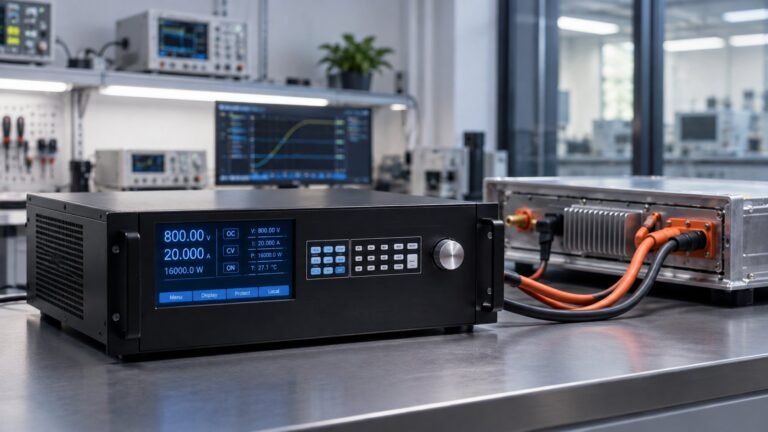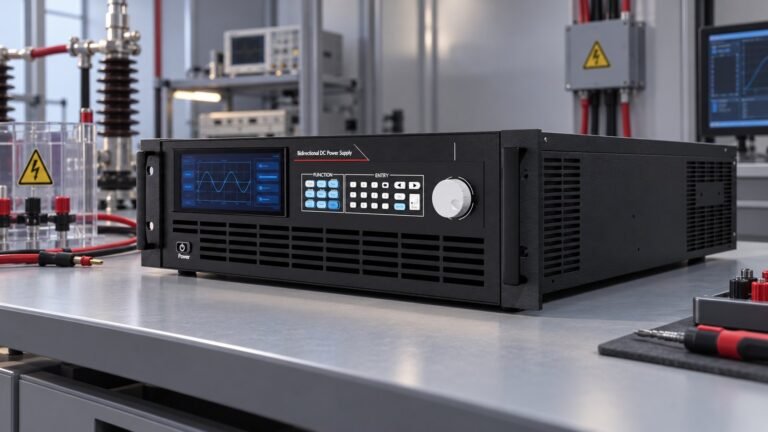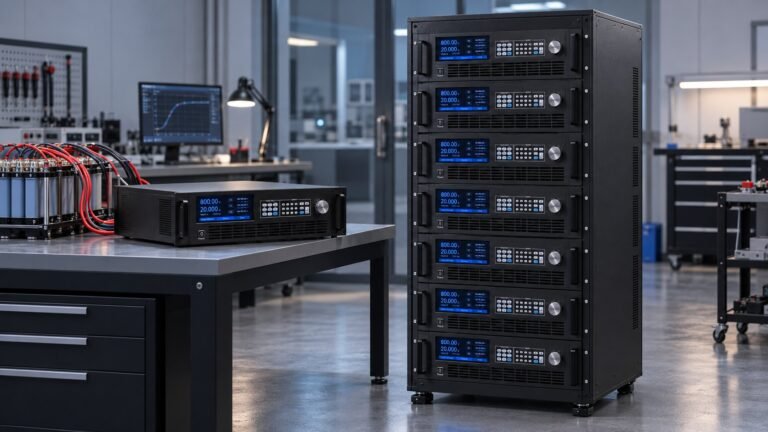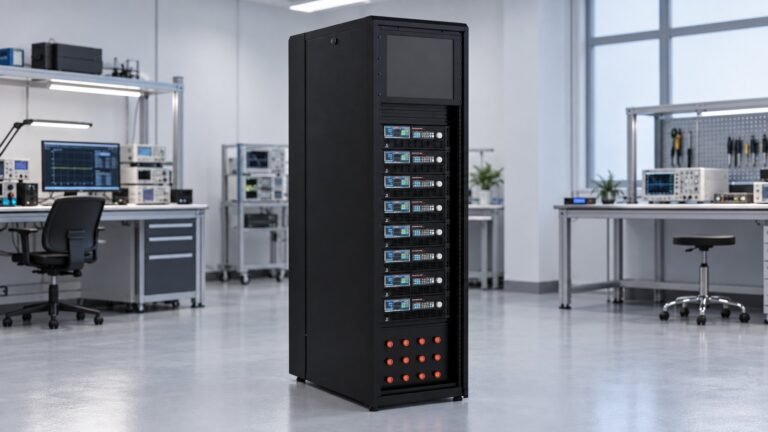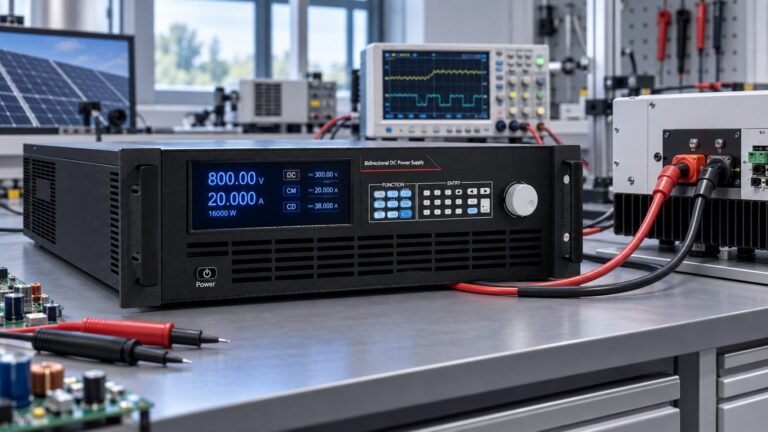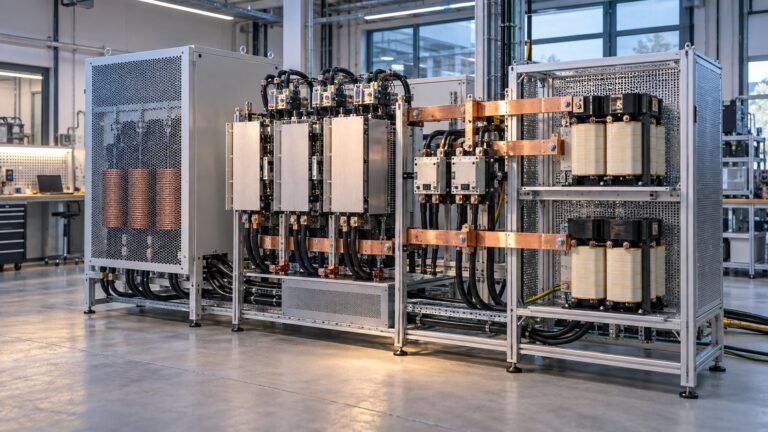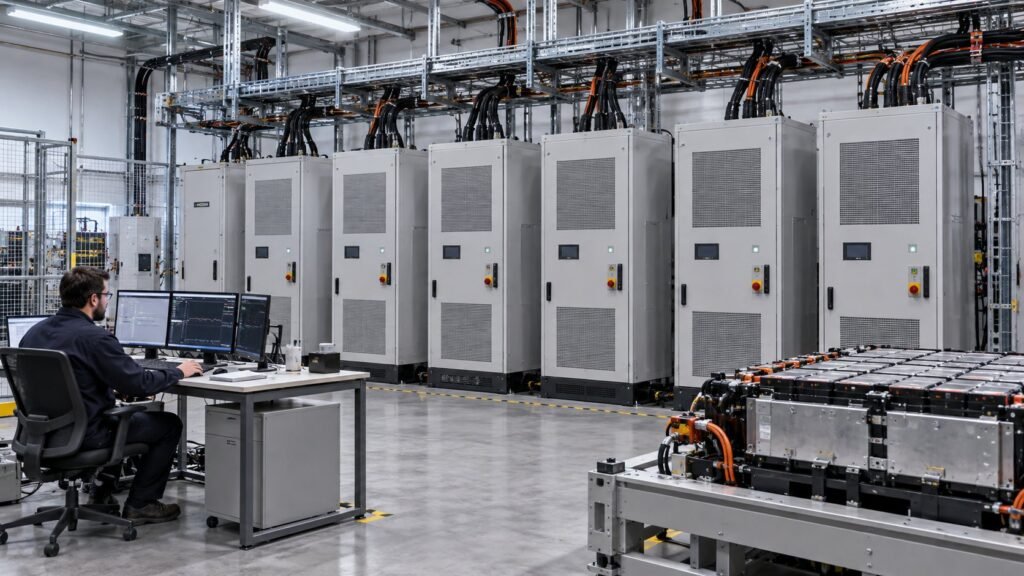
A megawatt bidirectional DC source sink test bench is built, not bought as one box. ActionPower’s NEXUS reaches 5 MW at 2000 V and 4500 A; its TITAN battery simulator scales to 10 MW only by running multiple 2000 V/1400 A units in parallel, per ActionPower. AMETEK’s Mi-BEAM and i-BEAM platforms follow the same rule — 1.2 MW and 1.3 MW respectively, both reached through parallel modules rather than a single frame, according to AMETEK Programmable Power. Chroma’s newest bidirectional DC line, aimed squarely at battery test and simulation, is built around the same logic. If you’re speccing a megawatt-class bench, the real design question isn’t the size of the box — it’s how the cabinets talk to each other.
EV and commercial-truck packs are pushing test benches into MW territory faster than single-chassis supplies can follow. Every vendor answering that demand does it the same way: parallel master/slave arrays of smaller bidirectional cabinets, not one custom-built giant unit. That’s the architecture story behind every megawatt battery pack test bench going into service this year, and it’s what we get asked about most when a lab moves from pack-level to platform-level testing.
Three Vendors, One Architecture Behind Every Megawatt Bidirectional DC Source Sink
Look at the numbers from any of the three major suppliers and the pattern repeats. AMETEK’s Mi-BEAM ships as 12.5–37.5 kW modules and only reaches its 1.2 MW ceiling by paralleling many of them under one control scheme. The i-BEAM series tops out at 650 kW as a single system and 1.3 MW once units run in parallel — AMETEK Programmable Power states both figures apply to parallel operation, not a single chassis.
ActionPower’s data makes the same point at a higher power band. The NEXUS DC power supply is rated 2000 V, 4500 A, 5 MW, described by ActionPower as a scalable architecture for high-power implementation. Its TITAN battery simulator, at 2000 V and 1400 A, reaches 10 MW specifically through parallel operation mode — not as a single 10 MW unit. Chroma positions its newest bidirectional DC line the same way: aimed at battery test and simulation at MW scale, built from smaller blocks run in parallel rather than one custom chassis.
The takeaway for anyone speccing a megawatt battery pack test bench: no supplier ships a single-box MW solution. Every MW-class figure in a bidirectional DC power supply datasheet is a parallel-array figure. That’s why evaluating a parallel bidirectional DC power supply means looking past the single-unit spec sheet to array-level behaviour — how many cabinets you need, how they synchronise, and how the array performs as one instrument.
See also: Programmable DC Source Sink: The Quadrant Map
Master/Slave Synchronisation and Current Sharing Across Cabinets
Every parallel bidirectional array needs one cabinet acting as master. The master accepts your setpoint — voltage, current, or power — and distributes proportional commands to every slave cabinet over a synchronisation bus. Without this, cabinets drift: one unit sources while another starts to sink, and you get circulating current instead of clean charge or discharge current into the pack.
Current Sharing Tolerance
In practice, we specify current sharing to within ±1–2% across cabinets in a parallel bank. Tighter than that adds cost for no test benefit; looser than that and one cabinet carries a disproportionate share of the load, ages faster, and trips its own protection before the array reaches rated power.
Cabling and Bus Bar Layout
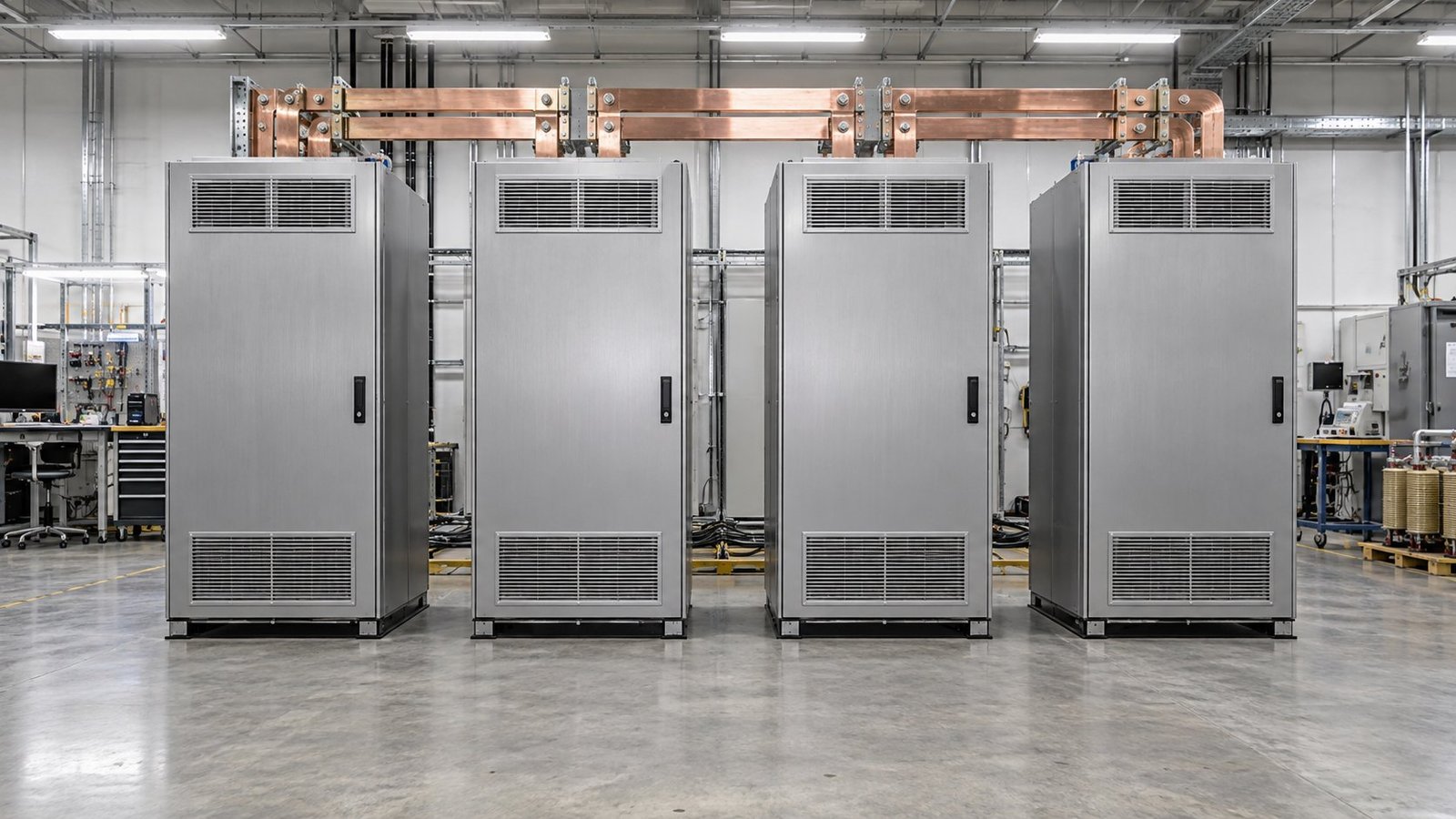
Cable and bus bar length between cabinets has to be matched, not just adequately rated. Unequal impedance between the master’s output and each slave’s output skews current sharing even when the control loop is otherwise correct. On a 2250 V, multi-cabinet bench, we lay out symmetrical bus bar runs before anything else in the physical build.
Single-Point SCPI/CAN Control for the Whole Array
Your test software shouldn’t need to know there are six cabinets behind the DUT terminals. SCPI over LAN gives you one address for the array’s setpoints and readbacks; CAN handles the fast cabinet-to-cabinet handshake that keeps master and slaves in step during a transient — a load dump, a fast-charge step, a fault. If your control layer has to address each cabinet individually, you’ve inherited an integration project, not a test bench.
This is also where a megawatt bidirectional DC source sink array earns its keep over a bank of unrelated supplies wired together. A true parallel system reports back as one source/sink with one set of limits, one fault state, and one data stream into your test sequencer — whether that’s NS81000 battery simulation software or your own SCADA layer.
Why Regenerative Sinking Is Mandatory Once You’re Absorbing Megawatts of Heat
At kilowatt scale, resistive dumping is an inconvenience — extra heat, a bigger chiller, a higher electricity bill. At megawatt scale, it isn’t viable. Dumping 1 MW of discharge power as resistive heat means rejecting roughly 1 MW of heat from the room, continuously, for the length of every discharge cycle. That’s a dedicated chiller plant sized like a small industrial process, not a lab accessory.
Regenerative sinking returns that energy to the mains instead, typically above 90% round-trip efficiency on modern bidirectional platforms. For a high-power battery pack cycler running back-to-back charge/discharge cycles, that efficiency difference is the difference between a bench that runs unattended overnight and one that needs its own substation. It’s also why every MW-scale battery test power supply on the market — AMETEK’s, ActionPower’s, Chroma’s, ours — is regenerative by default, not an option.
See also: Regenerative Load vs Electronic Load: Key Differences
Stacking 2250 V Cabinets Into a Megawatt-Class Pack Test Bench
This is the logic behind our own 2250 V bidirectional DC power supplies. Customers building a megawatt battery pack test bench for EV or commercial-truck packs don’t commission one custom-engineered 1 MW chassis — they stack multiple 2250 V-class cabinets under a shared master controller, the same way AMETEK and ActionPower scale their platforms. Add a cabinet, add roughly its rated power to the bench, and keep the control software and test sequences you already validated on the first unit.
Scaling this way changes what you have to plan for beyond the power electronics:
- Dedicated transformer capacity sized for peak regenerative feedback, not just peak draw
- Utility interconnection agreement and anti-islanding protection to IEEE 1547 or EN 50549
- Point-of-common-coupling harmonic filtering and power quality monitoring
- Switchgear rated for the combined array current, not each cabinet’s nameplate current
- A commissioning sequence that energises the master controller before any slave cabinet
None of this is exotic, but all of it has to be planned before the cabinets arrive. A lab that treats a 1 MW parallel array as six of the same power supply it already owns usually finds out at commissioning that the incoming supply, the switchgear, or the grid agreement wasn’t sized for six cabinets discharging in sync.
FAQ: Megawatt Bidirectional DC Source Sink Test Benches
How many cabinets do I need for a 1 MW battery pack test bench?
Divide your target power by a single cabinet’s rated power, then round up and add one spare slot for redundancy. A bench built from 250 kW-class cabinets needs four units for 1 MW plus headroom; the exact count depends on the voltage class and current rating you choose.
Can I mix voltage classes in one parallel array?
No. Master/slave synchronisation and current sharing assume matched voltage and current ratings across the array. Mixed classes need separate arrays with their own master, coordinated at the test-sequencer level instead of the power-hardware level.
Does paralleling cabinets reduce reliability?
It usually improves it. Losing one cabinet in a six-cabinet array drops available power by roughly one-sixth; losing the only unit in a single-chassis design stops the test entirely. The trade-off is added synchronisation hardware, which is why current sharing tolerance and CAN bus health are worth monitoring continuously.
Do I need a different grid connection for a megawatt-scale bench?
Almost always, yes. Above a few hundred kW of regenerative feedback, most sites need a utility interconnection agreement, dedicated transformer capacity, and anti-islanding protection. Plan this alongside the power hardware order, not after it arrives.
Speccing Your Own Megawatt-Class Array
If you’re scoping a bench for EV or commercial-truck pack testing at MW scale, start from the pack’s real charge/discharge profile, not a round power number. Our EV and battery pack test power supply page covers voltage, current, and cycling requirements at the pack level, and how they map onto a parallel array of 2250 V-class cabinets. → Request a quote for a cabinet count and control architecture sized to your pack.