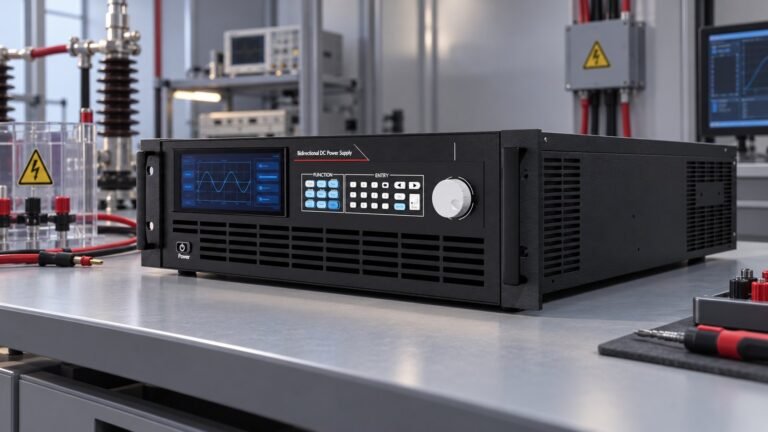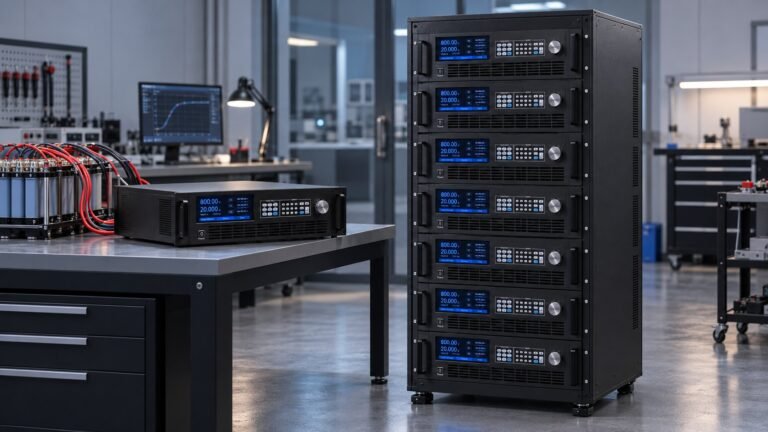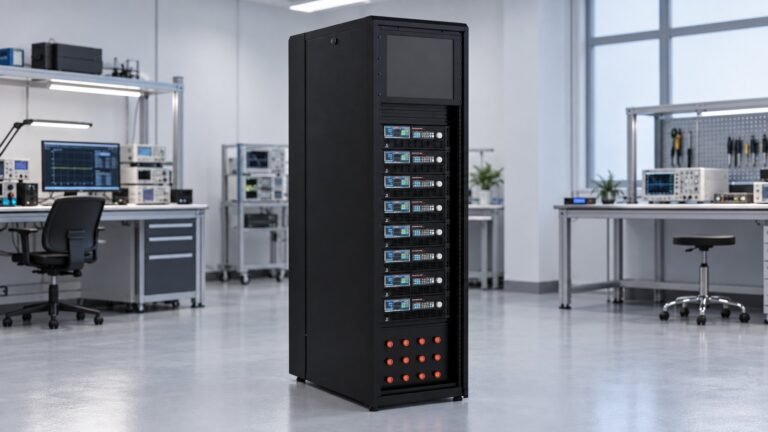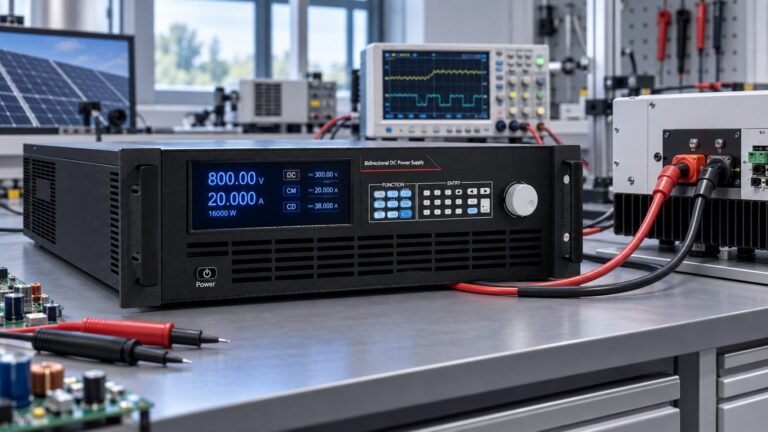
Choose a high voltage DC power supply by setting your maximum DUT voltage, adding transient margin, then checking current, power, sink capability and protections at that point. For an 800 V architecture, do not stop at 750 V: top-of-charge and transients can exceed the class. Select the next voltage class when headroom is inadequate.
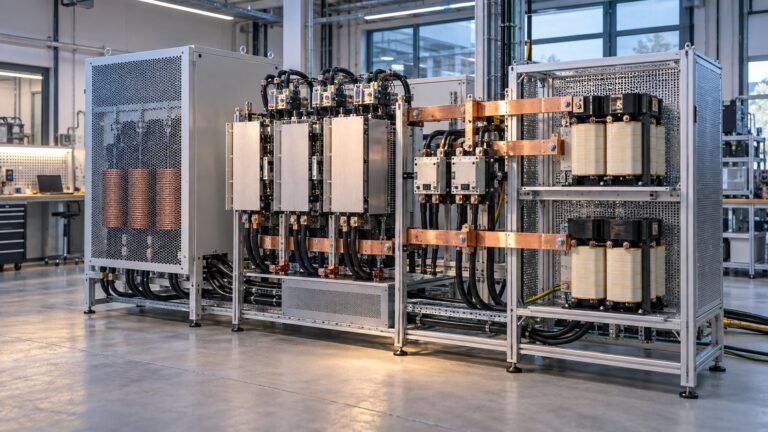
GW Instek’s August 2026 RBS expansion makes the choice concrete: 2250 V, 510 A, 20 kW or 30 kW in 3U, and up to ten identical units for 300 kW. This guide turns those figures into a test-bench decision method. It sits between PASCO’s 0–500 V, 50 mA SE-9700 and the 100 V–200 kV taxonomy described by Programmable Power.
How do you calculate the required voltage class?
The required DC voltage class is the DUT peak voltage plus a defined transient margin. Write the calculation before comparing models: Vrequired = Vmax DUT + transient margin. Then calculate current from the test power: I = P ÷ V. Use the highest credible operating point, not the nominal bus voltage.
Why can an 800 V architecture exceed 750 V?
GSAS states that an 800 V architecture can exceed 750 V at top-of-charge. A 750 V source therefore has no control headroom for a 780 V peak, even before wiring overshoot or a commanded transient. Treat the DC voltage class as an operating limit, not a label for the battery’s nominal voltage.
Worked example: 780 V peak
For a DUT reaching 780 V peak, specify a 30 V transient margin: Vrequired = 780 V + 30 V = 810 V. For a 24 kW test, I = 24,000 W ÷ 810 V = 29.6 A. A 1000 V class gives usable headroom. A 750 V unit reaches its ceiling, then clips at 750 V or trips on an over-range or OVP condition during top-of-charge.
Which source specifications should you compare?
Compare voltage, bidirectional current, continuous power, physical height and regenerative capability together. A 2250 V power supply may offer voltage headroom but less current at a fixed power rating. A lower class may deliver more current, but it fails if the DUT exceeds its output ceiling.
| Source or benchmark | Published specification | Use when |
|---|---|---|
| GW Instek RBS expansion | 20 kW or 30 kW in 3U; up to 2250 V and 510 A; up to ten identical units for 300 kW | You need a 2250 V regenerative platform with a modular 300 kW benchmark |
| Chroma 62450D-2000HL | 2,000 V and 45 kW in 4U; 360 kW in one rack; 1.8 MW across racks | You are benchmarking a 2,000 V source against rack-level power requirements |
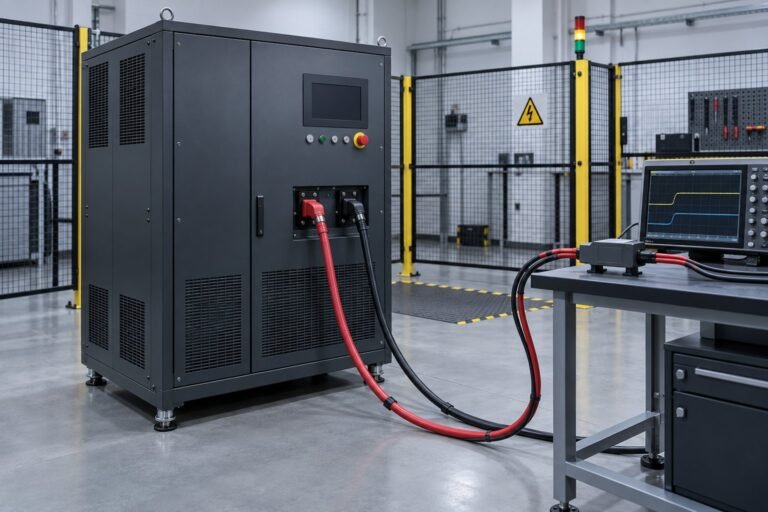
| Ultra N35542-1500-65 | 0–1500 V, ±65 A and ±42 kW in a 3U cabinet | Your DUT fits the 1500 V class and needs high current from one chassis |
GW Instek’s August 2026 release is the current trigger for the 2250 V class. Chroma’s current 62450D-2000HL announcement sets a second benchmark at 2,000 V and 45 kW in 4U. Use both as comparison points, then size your own DUT’s voltage headroom and current rather than selecting by maximum headline power.
What does Ultra specify in the N35500 platform?
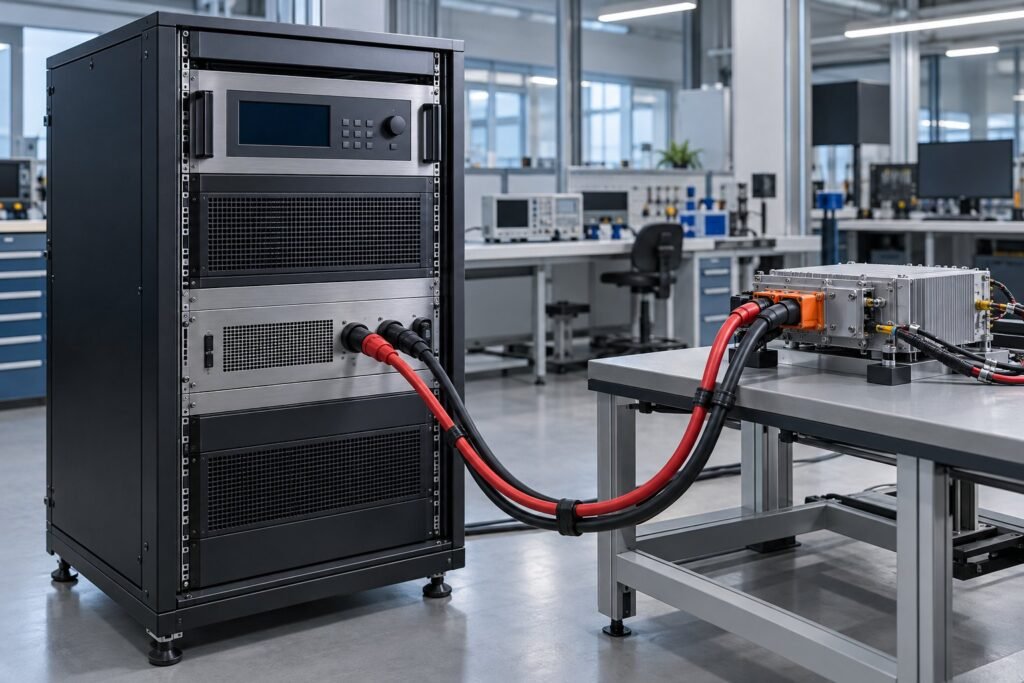
Ultra Power Systems’ N35500 platform covers bidirectional and regenerative DC power supplies from 360 V to 2250 V classes. In practice, I specify the N35542-1500-65 when a 1500 V DUT needs source and sink operation, ±65 A, and ±42 kW from one 3U unit.
The N35542-1500-65 uses a 19-inch, 3U cabinet. Its physical clearance envelope is 132 mm high × 482 mm wide × 755 mm deep with the shield fitted. The configured build provides 0–1500 V output, ±65 A current, ±42 kW power, ≤3 V p-p voltage ripple, ≤0.4 V rms ripple, and voltage rise and fall times of ≤5 ms.
For protection and integration, specify OVP, OCP, OPP, UVP and UCP limits in the test plan. The N35542-1500-65 lists 1500 V DC output-to-ground isolation, 0.02% + 0.02% F.S. voltage-setting accuracy, and LAN, RS232, RS485 and CAN interfaces. See the Ultra 1500 V bidirectional power supply class for the configured range.
See also: Automating a DC Power Supply with SCPI, Modbus & CANopen
How do you size current, power and regenerative sink?
Size a high-power DC supply from the worst-case product of voltage and current, then verify the sink rating for returned energy. Use P = V × I for the DUT operating point. At 780 V and 30 kW, the required current is 38.5 A. At 1500 V and 42 kW, the required current is 28 A.
- Record the DUT’s maximum voltage, peak current and continuous power. Failure mode: an average value hides a top-of-charge or startup excursion.
- Add transient margin to Vmax DUT before selecting the DC voltage class. Failure mode: a 750 V unit clips or trips when the DUT reaches 780 V.
- Calculate I = P ÷ V at the lowest test voltage that still carries the required power. Failure mode: current limiting distorts the DUT waveform and invalidates the test.
- Check source and sink ratings separately. Failure mode: the source passes startup, but the regenerative load trips during deceleration or discharge.
- Confirm ripple, response time, isolation and protection thresholds against the DUT limits. Failure mode: output ripple or a slow transient response is mistaken for DUT behaviour.
A programmable high-voltage supply also needs enough dynamic response for the test waveform. Ultra’s N35500 platform lists voltage response of ≤5 ms, transient recovery below 4.5 ms for a representative 10% to 60% load change, and regenerative efficiency up to 93%. Specify the measurement bandwidth and test condition with those figures.
See also: Regenerative DC Electronic Load for High-Power Testing
High voltage DC power supply FAQ
Is 750 V enough for an 800 V architecture?
Not if the DUT can reach more than 750 V. For a 780 V peak, add transient margin and select at least an 810 V capability. A 1000 V class is the practical next choice.
When should you choose a 1500 V or 2250 V class?
Choose 1500 V when the DUT and transients remain below that limit with margin. Choose 2250 V when the DUT, insulation system or future test envelope needs higher headroom. Do not trade away required current without checking I = P ÷ V.
Which protection limits belong in the specification?
Specify over-voltage, over-current, over-power, under-voltage and under-current protection, plus output-to-ground isolation. Record the trip thresholds, reset behaviour and response time for every automated test sequence.
Which high voltage DC power supply should you specify?
Specify the voltage class from Vmax DUT plus transient margin, then verify current with I = P ÷ V. For 780 V peak testing, a 750 V unit is undersized. For 1500 V testing up to 42 kW, Ultra’s N35542-1500-65 provides a defined 3U source-and-sink configuration.
For higher-voltage test benches, review our 2250 V bidirectional DC power supply range and compare its voltage headroom, current, ripple, response time and protection limits with your DUT. For a configured build, request a test-bench quote →